
Vision AI for Enterprise Security: Benefits, Use Cases, and Future Trends
Enterprise security has outgrown the recorded tape. The goal today is not to review footage after something goes wrong, but to understand and analyze live video feeds and act in real time. Vision AI delivers this by applying computer vision and deep learning to live feeds, turning ordinary cameras into an intelligent layer that detects threats, flags safety violations, and surfaces risk the moment they appear. For organizations running hundreds of feeds no human team can watch at once, this is the difference between passive recording and active protection.
What Is Vision AI in Enterprise Security?
Vision AI is software that analyzes video automatically, recognizing objects, people, behaviors, and events without manual review. In a security context, it interprets live feeds and triggers an instant alert when a specific condition appears, such as:
- An unauthorized person entering a restricted zone
- Smoke or fire forming in a storage area
- A worker missing required protective equipment
- A vehicle moving the wrong way through a controlled area
Unlike rigid motion triggers, modern vision AI understands context. It separates a person from a shadow and a real hazard from a false alarm, which is what makes its alerts trustworthy rather than noise operators learn to ignore.
Why Are Enterprises Adopting Vision AI for Security?
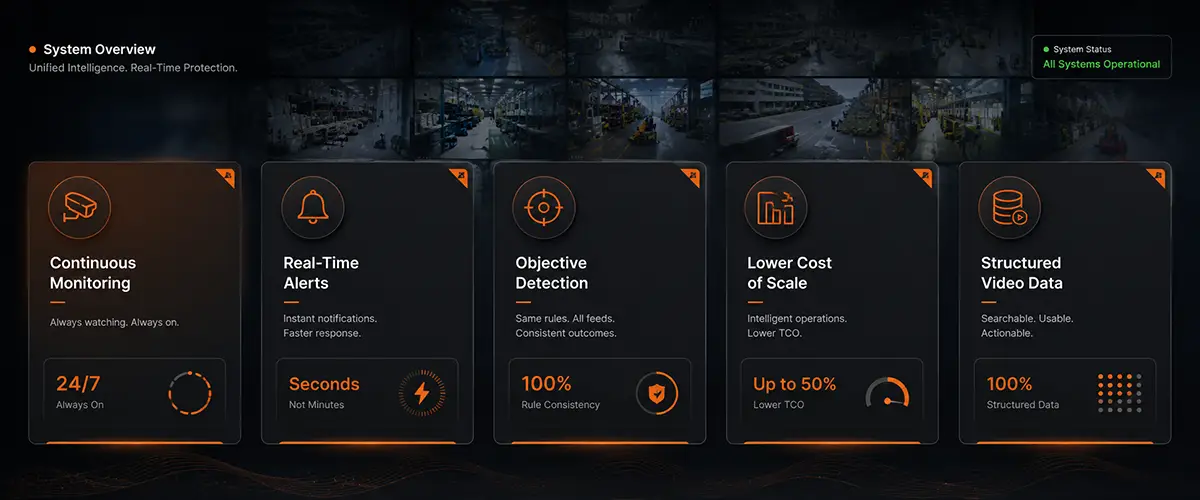
Enterprises adopt vision AI because it upgrades existing camera infrastructure into an active asset instead of a forensic archive. The software runs on feeds an organization already operates, so value comes from intelligence rather than new hardware. The core benefits hold across every industry:
- Continuous monitoring that never tires or looks away
- Real-time alerting that cuts response from minutes to seconds
- Objective detection applying one standard to every feed and hour
- Lower cost of scale, since coverage becomes a software task, not a staffing one
- Structured data from video, revealing safety trends and compliance gaps that were previously invisible
Together these shift security from a reactive cost center into a source of operational intelligence.
What Are the Main Use Cases for Vision AI in Enterprise Security?
The same core technology adapts to very different risks across sectors.
How Does Vision AI Improve Safety in Oil and Gas?
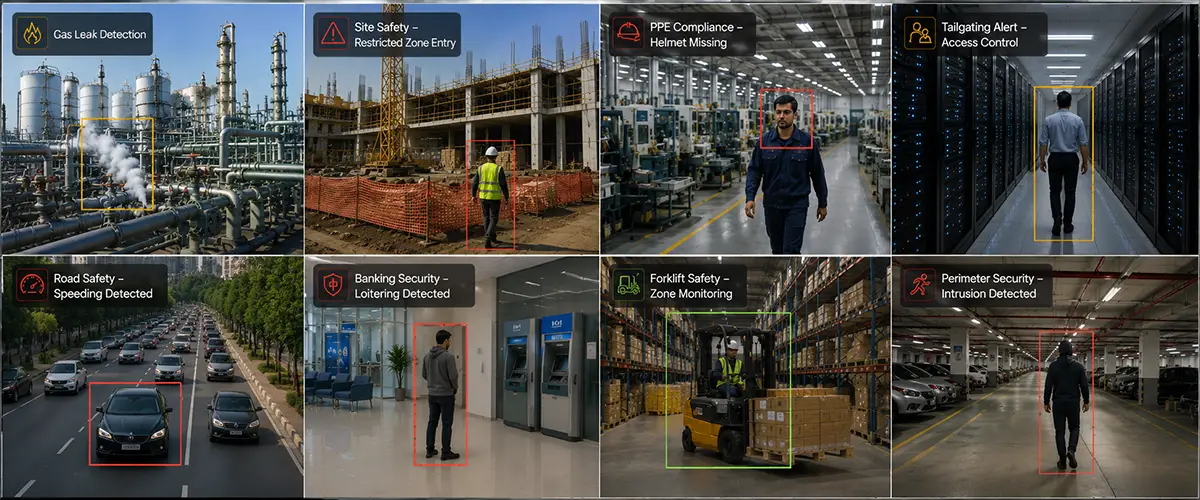
Oil and gas sites carry hazards where early detection prevents catastrophe. An AI gas leak detection system analyzes visual and thermal feeds to catch leaks and vapor releases as they emerge, alerting teams before a hazard can spread or ignite. It watches remote, high-risk zones that are impractical to patrol constantly and logs every detection for compliance.
How Is Vision AI Used on Construction Sites?
Construction sites change hourly and mix workers with heavy equipment. AI-powered construction site monitoring software tracks activity to flag unsafe behavior, restricted-zone entry, and equipment misuse as it happens, giving managers a live view of safety and progress while building an evidence trail for accountability.
How Does Vision AI Enforce Safety in Manufacturing?
Protective gear is mandatory on the factory floor but inconsistently worn, and manual checks cannot cover every shift. AI PPE violation detection for manufacturing automatically spots a missing helmet, vest, or gloves and alerts supervisors without delay, replacing periodic spot checks with continuous verification and reducing both injury risk and compliance exposure.
How Does Vision AI Support Fire, Smoke, and Intrusion Response?
Two threats demand the fastest response at any facility: fire and unauthorized entry.
- Fire and smoke detection AI identifies the earliest visual signs of combustion, often before traditional sensors react, buying time for evacuation.
- An intrusion detection system recognizes people entering secured areas and escalates within seconds, so a breach becomes an alert rather than a discovery on the next patrol.
Because both run on the same video layer, one platform can watch for each at once.
How Is Vision AI Used to Secure Data Centers?
Data centres treat physical access as seriously as network security. A smart surveillance system for data centres monitors entries, aisles, and restricted racks to detect tailgating and unusual movement. Vision AI for data centres verifies who is present and where, ensuring only authorized personnel reach sensitive infrastructure and every anomaly is logged the moment it occurs. Every access event – authorized or not – is timestamped and retained, giving facility and compliance teams an audit trail they can produce on demand rather than reconstruct after the fact.
How Does Vision AI Improve Traffic and Transportation Safety?
Roads generate constant risk no team can watch manually at scale. AI-based road safety enforcement detects violations such as speeding, wrong-way driving, and signal jumping automatically, applying rules uniformly across every lane. A traffic surveillance AI system extends this to flow monitoring, incident detection, and congestion analysis, giving authorities enforcement plus the data to make roads safer.
How Does Vision AI Strengthen Security in Banking and Finance?
Banks face threats from physical intrusion to fraud at branches and ATMs. AI security monitoring for banks watches high-risk areas for suspicious behavior, loitering, and unauthorized access, while real-time banking security analysis processes those feeds so a developing threat triggers action rather than a delayed review, protecting people and assets while creating a record for audits.
What Future Trends Will Shape Vision AI in Enterprise Security?
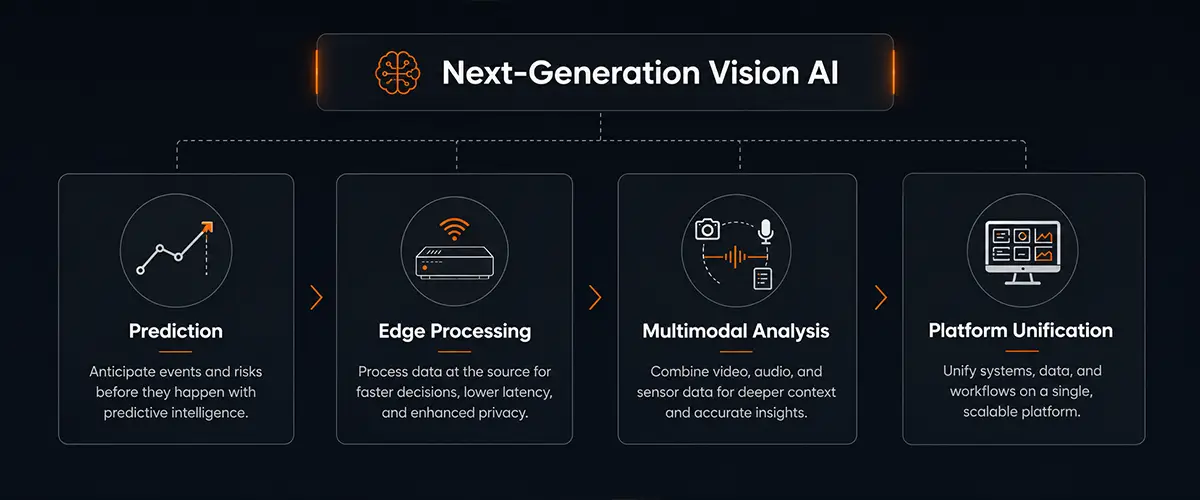
Vision AI is moving from systems that detect to systems that reason. Several shifts define what comes next:
- From detection to prediction: recognizing patterns that precede an incident, not just the incident itself
- Edge processing: running analysis on site to cut latency and keep sensitive video local
- Multimodal analysis: combining visual data with other signals for a more accurate picture
- Platform unification: consolidating fragmented point tools into single systems
The clear direction is consolidation, replacing a dozen vendors and dashboards with one intelligent layer that makes vision AI sustainable at enterprise scale.
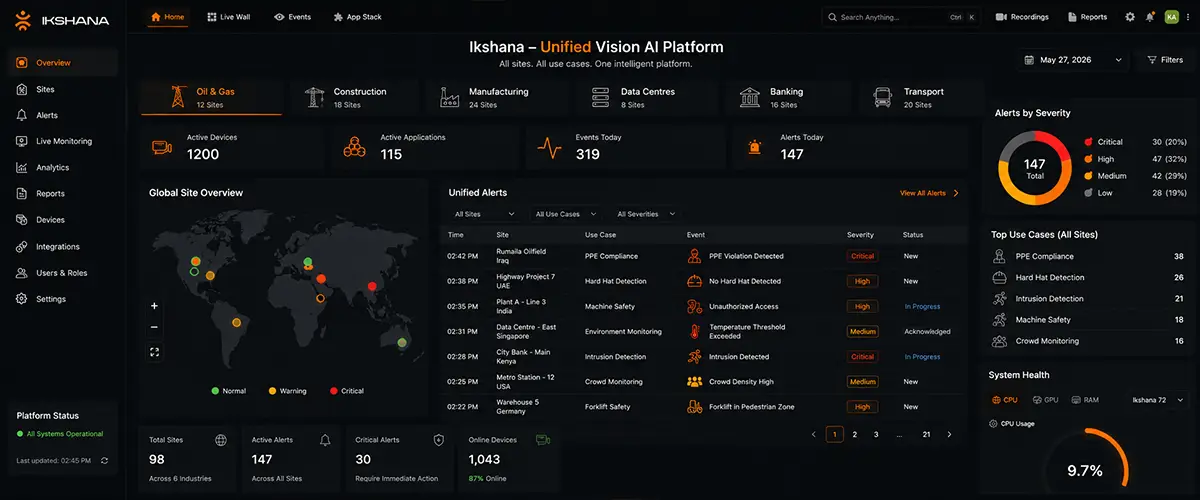
How Does Ikshana Bring Vision AI Together for the Enterprise?
Most organizations do not need separate tools for gas detection, PPE compliance, intrusion, fire, and traffic. They need one system that does all of it on the video they already run. Ikshana is Intozi’s unified AI video analytics platform built for exactly this, applying computer vision across existing feeds to deliver real-time detection for safety, security, and operations from a single interface. Every use case runs under a common system; it works with cameras an enterprise already owns, and its alerts, records, and analytics live in one place as a single source of truth across sites.
Conclusion
Vision AI turns enterprise video from a record of what went wrong into a system that acts while it still matters. Across oil and gas, construction, manufacturing, data centres, banking, and transportation, it adapts to each environment while delivering the same promise of continuous, real-time awareness. Intozi’s Ikshana platform brings this together over the cameras an enterprise already runs on.
Frequently Asked Questions
Upgrade Your Operations With Next-Generation AI Video Analytics
Intozi Tech Pvt Ltd
Unit no- 629, 644, 645 Tower B2, Spaze I-Tech Park, Sohna Road Sec 49, Gurgaon, Haryana-122018
MON-FRI 09:00 - 20:00, SAT 10:00 - 14:00