
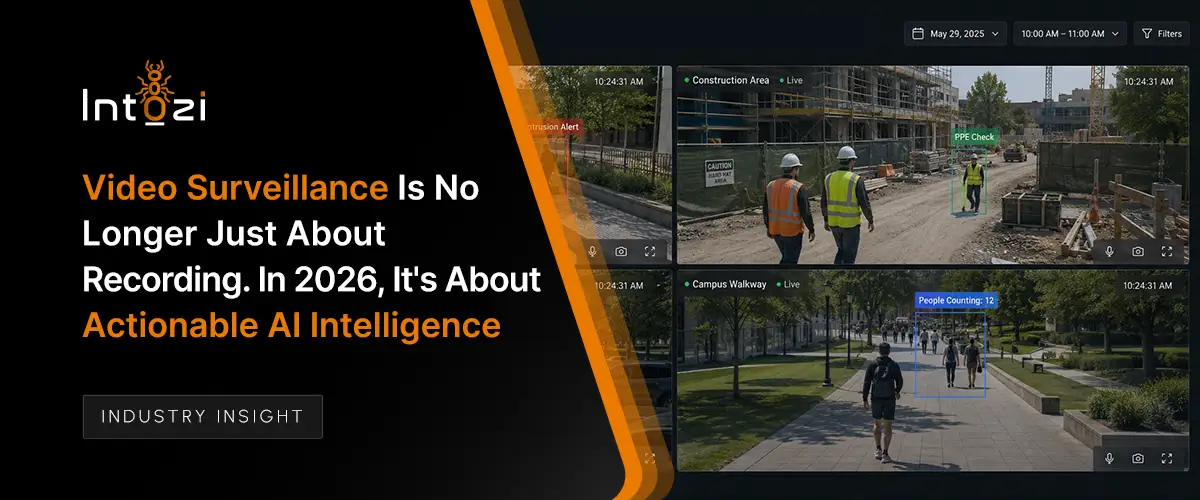
Video Surveillance Is No Longer Just About Recording. In 2026, It's About Actionable AI Intelligence.
The single biggest change in surveillance technology this decade is that AI video surveillance has inverted the job of a camera: it no longer exists to be reviewed after an incident; it exists to prevent one. For more than twenty years, cameras were recording devices. In 2026, they are intelligence devices. A modern video feed does not wait to be watched; it monitors, interprets, and alerts on its own. This is the shift from passive recording to real-time decision-ready intelligence, and it is redefining what organizations expect from every camera they own.
The Core Shift: Recording Is a Cost, Intelligence Is a Return
Recording captures what has already happened. Intelligence influences what happens next. That is the entire distinction, and it is why surveillance budgets are moving away from storage toward analytics. A camera that records is an expense with no payback until something goes wrong. A camera that understands your environment generates continuous value by detecting, classifying, and alerting in real time.
Intozi is an AI video analytics company that builds systems designed to interpret rather than merely store. The benchmark is simple: a camera watching a site should distinguish a worker from an intruder and a forklift person from a pedestrian and act on that difference instantly.
What “Actionable Intelligence” Means in Precise Terms
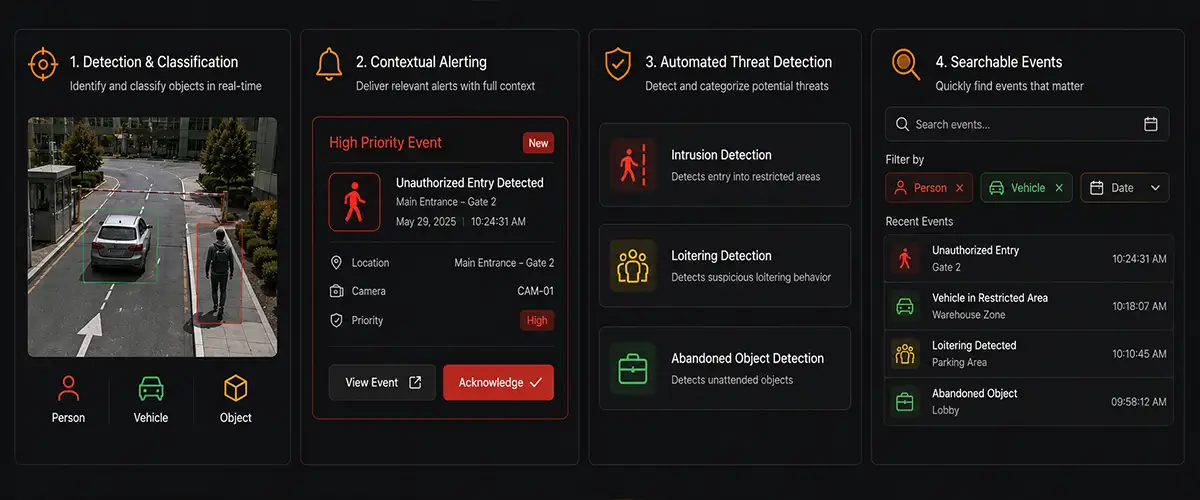
Actionable video intelligence is the software layer that converts raw video into insights that people or systems can act on immediately. It is defined by four measurable capabilities:
- Detection and classification: Identifying people, vehicles, and objects with high confidence, not triggering shadows or weather.
- Contextual alerting: Notifying operators only on events that matter, eliminating the alarm fatigue that makes legacy systems ignorable.
- Automated threat detection: Recognizing intrusions, loitering, abandoned objects, and unsafe behavior the moment they occur.
- Searchable events: Querying hours of footage by attribute, objects, or events in seconds instead of scrubbing timelines manually.
The practical effect is that teams stop staring at monitors and start responding to verified events, which changes staffing, cost structure, and reliability all at once.
The Engine Behind It: Modern Video Analytics Software
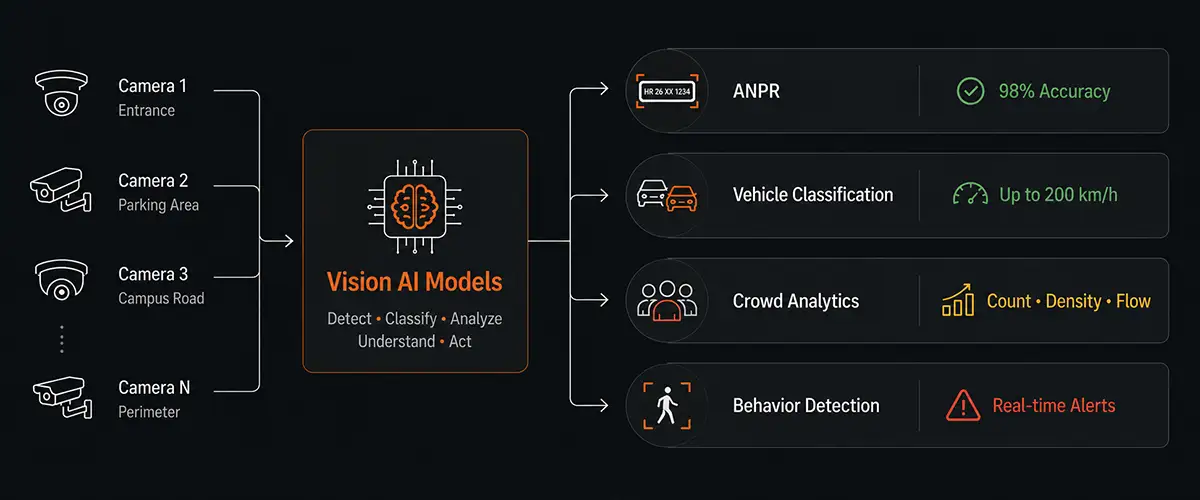
The reason 2026 is different from 2020 is that video analytics software now runs on Vision AI models that understand a scene the way a trained observer would, not by traditional motion detection or comparing pixel differences between frames. A single deployment can simultaneously classify vehicle types, read license plates, count crowds, and detect a fall or a fight, all without a human in the loop.
Intozi’s platform is built on this principle, with field-validated specifications: 98% ANPR accuracy, speed detection up to 225 km/h, and recognition across eight vehicle classes. Specifications like these matter because intelligence is only actionable when it is accurate enough to trust without second-guessing every alert.
Why Real-Time Processing Is the Deciding Factor
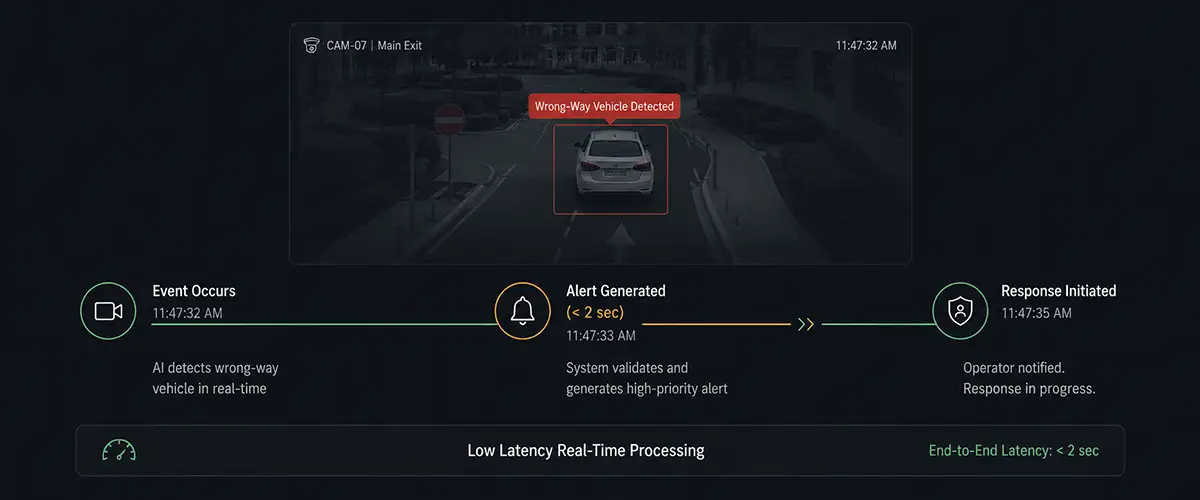
Speed is the entire difference between a record and a rescue. An alert delivered thirty minutes after a wrong-way driver enters a highway documents a problem. The same alert delivered in seconds can help prevent an incident. Real-time video surveillance processes streams as they arrive and routes alerts to the people who can act, which is what separates a 2026 deployment from a legacy DVR.
The question a modern system answers is not “what happened?” but “what is happening, and what do we do now?” Low-latency inference makes that immediacy possible across hundreds of simultaneous feeds without flooding operators with unnecessary alerts.
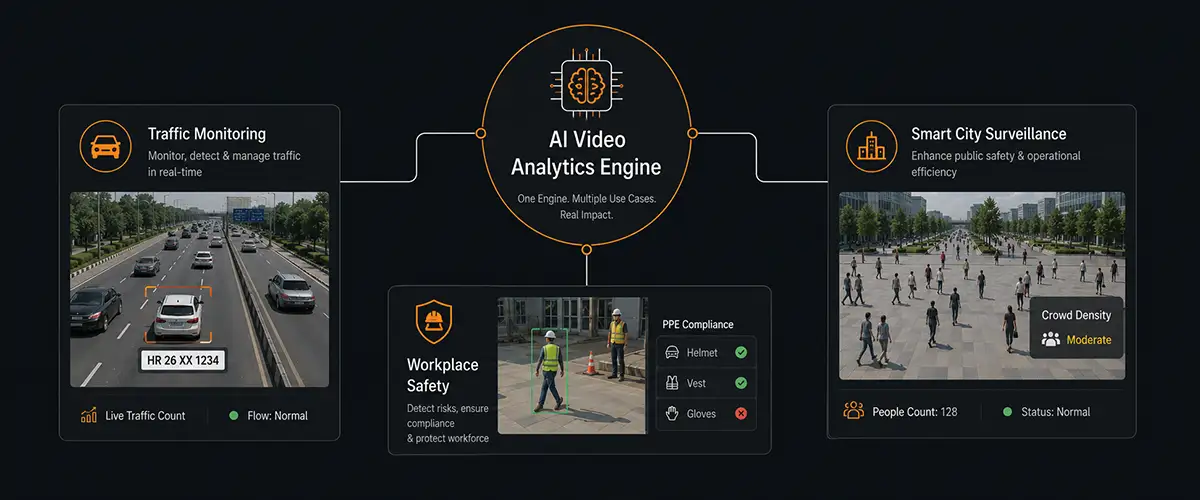
One Engine, Many Domains
A genuinely intelligent video surveillance system is defined by its ability to serve multiple environments from the same analytics core, which is what makes the economics work. Intozi applies one engine across multiple high-value domains:
- Traffic monitoring: detecting violations, measuring traffic flow, reading license plates, and providing actionable data for traffic management and enforcement.
- Workplace safety: flagging missing PPE, unsafe proximity to machinery, restricted-area breaches, and other risks before they result in incidents.
- Smart city surveillance: unifying distributed cameras into a single intelligence layer for public spaces, transit, and civic infrastructure.
Because every domain runs on the same engine, an accuracy gain in one immediately benefits the others.
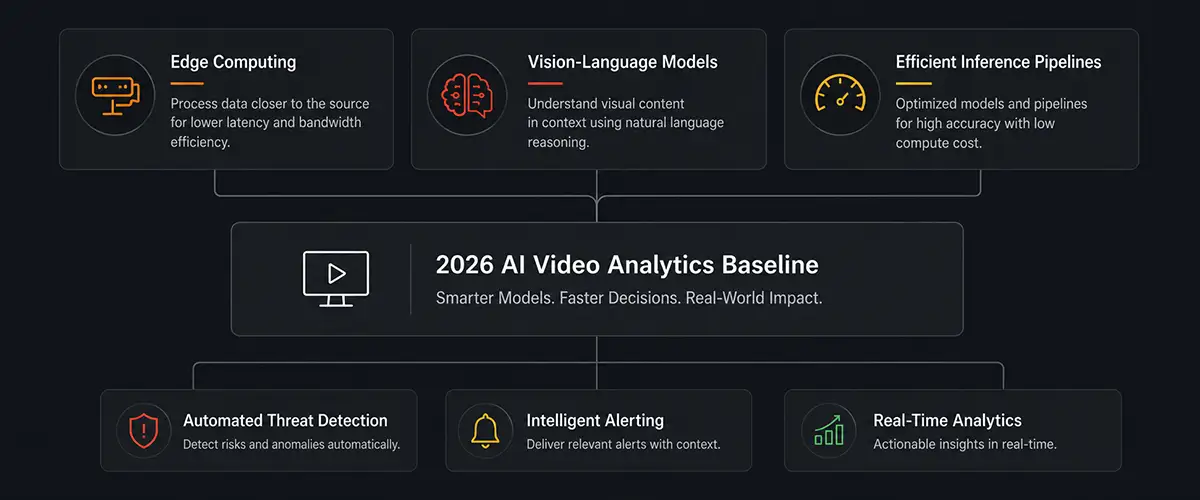
Why 2026 Marks A Turning Point
Several technology trends have matured to make AI-powered video analytics more practical and accessible than ever before. Edge computing has become economical and powerful enough to run sophisticated models on-site; vision-language models have matured to describe scenes in human terms, and inference pipelines have become efficient enough to handle real-time workloads on practical hardware budgets.
The consequence is concrete: automated threat detection, intelligent alerting, and real-time analytics are no longer premium capabilities reserved for high-security sites. They are the 2026 baseline, and organizations still treating cameras as passive recorders now operate at a measurable, quantifiable disadvantage against competitors running analytics on every frame.
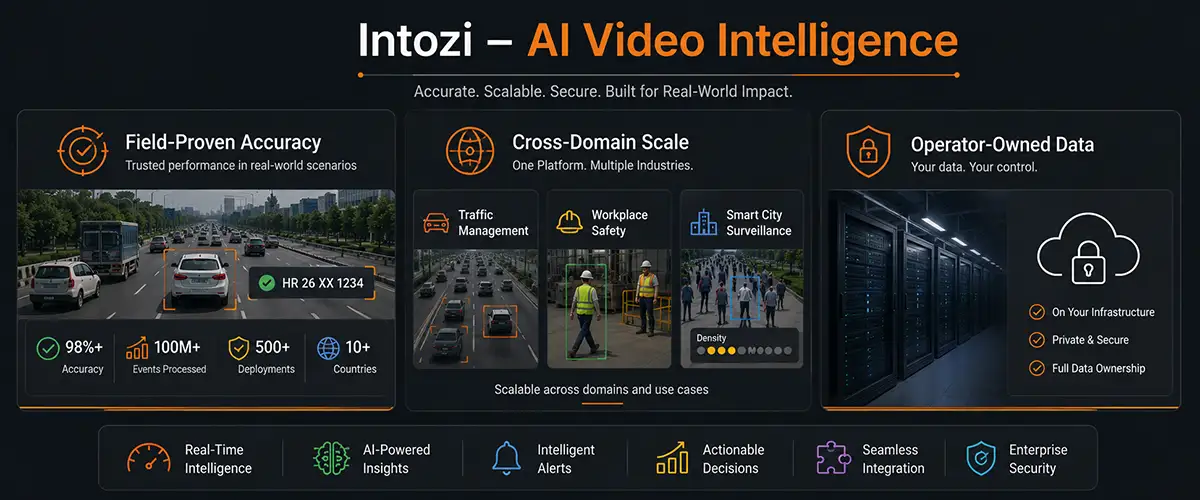
Why Intozi Leads This Shift
Intozi is an AI video analytics company focused on turning live camera feeds into reliable, real-world decisions rather than archived footage. What distinguishes it:
- Field-proven accuracy: specifications validated in real-world deployments, not lab conditions.
- Cross-domain scale: one engine serving diverse use cases across traffic, safety, and smart cities.
- Operator-owned data: processing remains on infrastructure the customer controls.
Inside Ikshana: Intozi’s Intelligence Platform
Ikshana is Intozi’s unified video analytics platform, replacing disconnected point solutions with one coherent system that manages every connected camera from a single place. It is built to deploy new capabilities without re-architecting their existing infrastructure. Its core strengths include the following:
- Centralized models: detection, classification, analysis, and alerting in one stack.
- Effortless scaling: new sites, cameras, and capabilities added without rebuilding the system.
- Data sovereignty: video processing and storage stay under the operator’s control.
The Bottom Line: The Camera Is Now a Decision-Maker
The defining truth of 2026 is that surveillance has stopped being a rear-view mirror and become a windshield. Cameras no longer just record, they analyze and enable organizations to respond in real time. With Intozi, organizations gain faster response times, lower operational overhead, and proactive security that enables action before incidents occur rather than after. The footage was never the point. The intelligence always was, and in 2026 it is accessible, affordable, and proven.
Frequently Asked Questions (FAQs)
Upgrade Your Operations With Next-Generation AI Video Analytics
Intozi Tech Pvt Ltd
Unit no- 629, 644, 645 Tower B2, Spaze I-Tech Park, Sohna Road Sec 49, Gurgaon, Haryana-122018
MON-FRI 09:00 - 20:00, SAT 10:00 - 14:00