
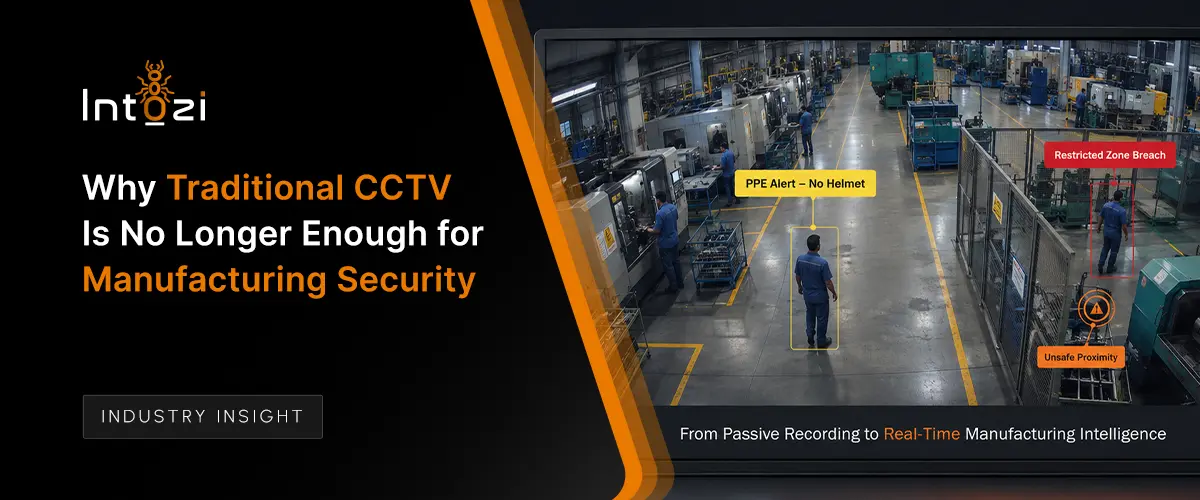
Why Traditional CCTV Is No Longer Enough for Manufacturing Security
For decades, manufacturers treated CCTV as the backbone of plant security. Cameras went up, footage was recorded, and if something went wrong, someone reviewed the tape. That model made sense when the goal was evidence after the fact. It’s the wrong model for a modern factory that generates more video than any team can watch and expects that video to prevent incidents, not just document them. Traditional CCTV records everything and understands nothing, and that gap is exactly where manufacturing risk now lives.
The shift is not about replacing cameras. It is about what the cameras feed into. AI-driven analysis turns the same footage into a system that recognizes hazards, violations, and intrusions as they happen, closing the delay between an event and a response. Understanding why passive recording no longer fits the factory floor is the first step toward fixing it.
What Are the Limits of Traditional CCTV in Manufacturing?
Traditional CCTV was built to capture and store, not to interpret. On a factory floor, that design creates blind spots that grow with every camera added. The core limitations are consistent across plants:
- It is reactive, not preventive. Footage is reviewed after an incident, so CCTV documents what went wrong rather than stopping it.
- It depends on human attention. Operators cannot watch dozens of feeds continuously, and attention fades within minutes, so incidents are missed in real time.
- It scales poorly. More cameras mean more footage and more blind spots, not more security.
- It produces no usable data. Hours of recording yield no measurable insight into safety trends, compliance gaps, or recurring risks.
The result is a system that feels like coverage but behaves like an archive. It is only as useful as the person available to watch it, which on a busy plant floor is rarely enough.
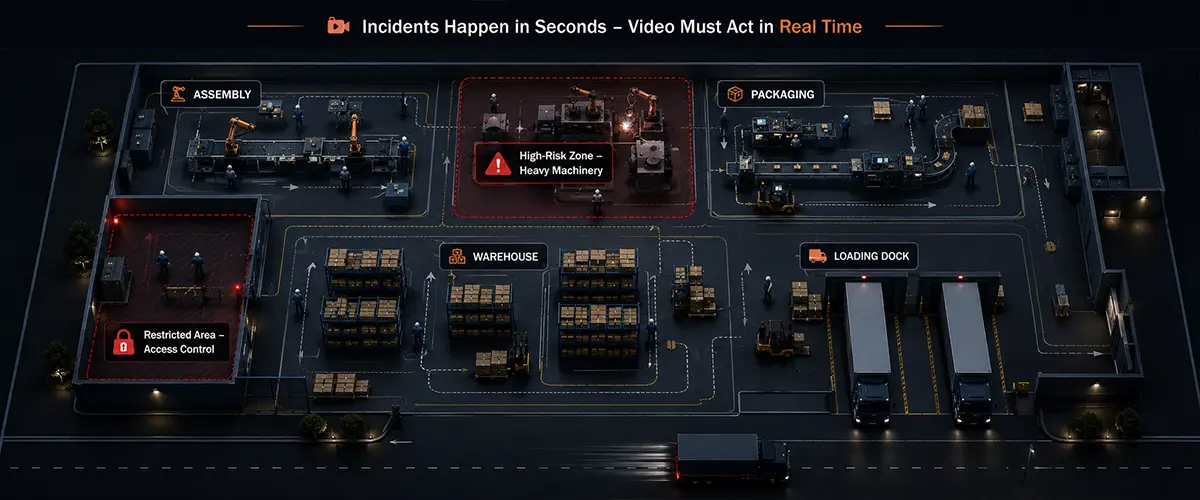
Why Does Manufacturing Need More Than Passive Recording?
Manufacturing environments combine heavy machinery, strict safety requirements, restricted zones, and constant movement of people and materials. Each of those is a source of risk that unfolds in seconds, faster than any after-the-fact review can address. The rise of AI in manufacturing and production has raised the baseline for what plants expect from every system on the floor, and security is no exception. A camera that only records is now the weakest link in an otherwise intelligent operation.
What manufacturers need is a system that watches continuously, understands what it sees, and acts the moment a condition appears. That is the difference between a plant that reviews an accident and one that prevents it.
How Does AI Video Analytics Change Manufacturing Security?
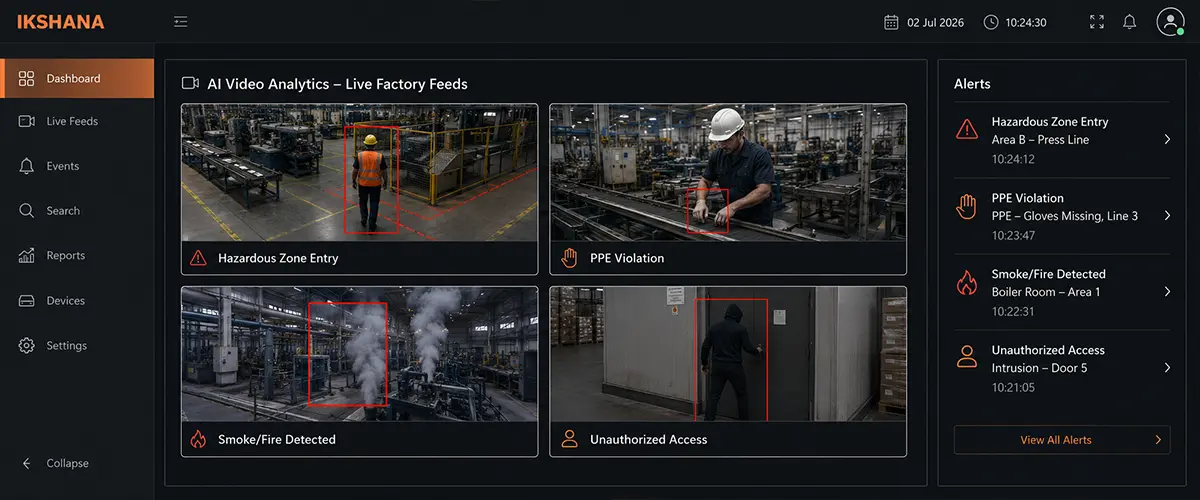
The upgrade path is not new hardware but new intelligence layered onto existing feeds. AI video analytics for manufacturing applies computer vision to live camera streams to detect specific events automatically, turning passive footage into real-time awareness. Instead of storing video for later, the system interprets it now and alerts the right people instantly.
In practice, manufacturing video analytics watches for the conditions that matter most on a plant floor and flags them as they happen:
- Workers entering restricted or hazardous zones
- Missing protective equipment such as helmets, vests, or gloves
- Fire, smoke, or early signs of equipment failure
- Unauthorized access to secured areas
- Unsafe proximity between people and moving machinery
Because the analysis runs on cameras a plant already operates, the value comes from intelligence rather than a hardware overhaul. The same feeds that once sat idle become an active safety and security layer.
What Can AI Monitoring Detect on the Factory Floor?
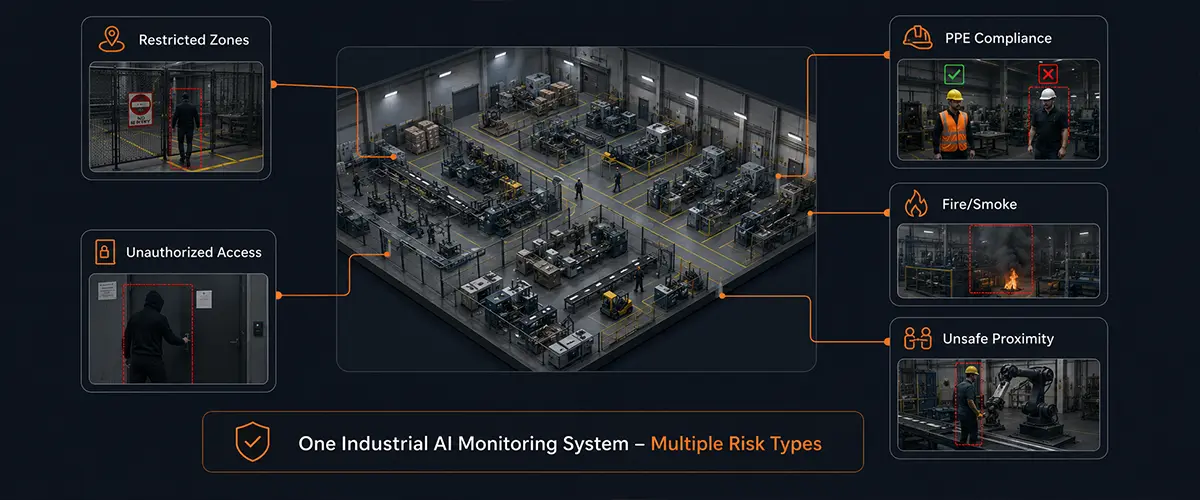
A modern industrial AI monitoring system goes beyond security alerts to give plant leaders a live, measurable picture of the floor. It applies consistent logic to every feed at every hour, something no human team can sustain, and it converts what it sees into structured data.
This means a single system can track safety compliance, security breaches, and operational anomalies at once, then surface trends that were previously invisible. Leaders gain not just alerts but evidence: how often violations occur, where incidents cluster, and which zones carry the most risk. That intelligence turns security spending into an operational asset rather than a sunk cost.
How Does AI Improve Worker Safety on the Factory Floor?
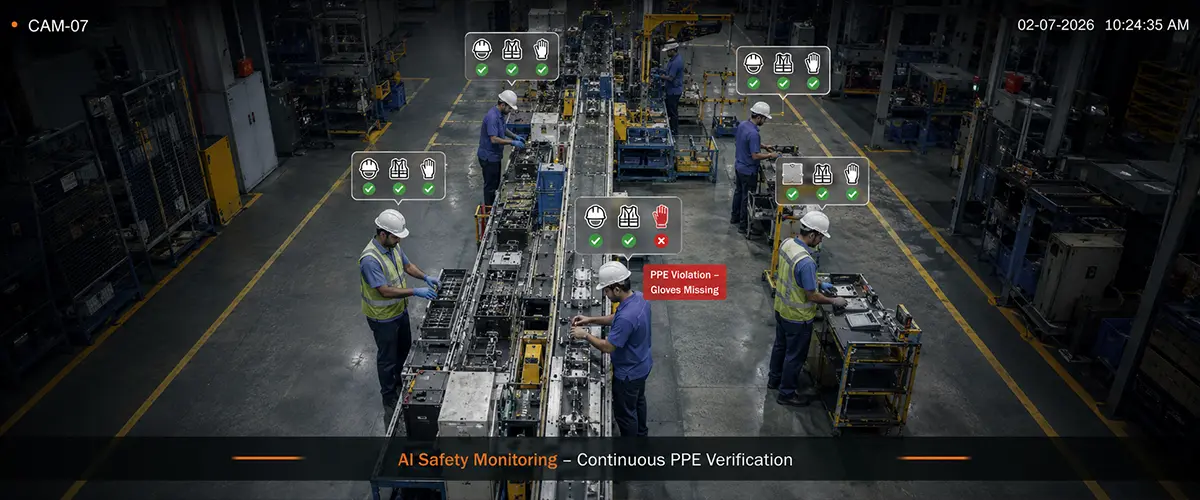
Security and safety are inseparable in manufacturing, and this is where AI delivers its clearest return. An AI-powered industrial safety solution continuously verifies that workers follow safety protocols, wear required protective equipment, and stay clear of hazardous zones, alerting supervisors the instant a rule is broken.
The impact is a shift from periodic spot checks to constant verification. Rather than relying on a supervisor happening to see a violation, every worker on every shift is covered by the same standard, in real time. This reduces injuries, strengthens regulatory compliance, and builds a reliable record that protects both the workforce and the business.
How Does Ikshana Modernize Manufacturing Security?
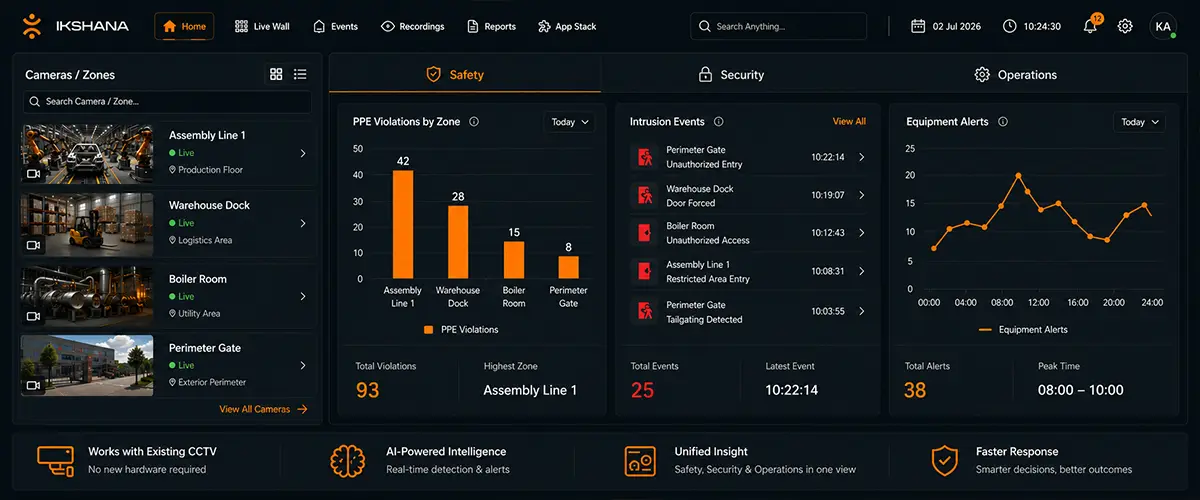
Most plants do not need a separate tool for PPE compliance, another for intrusion, and a third for hazard detection. They need one system that does all of it on the video they already run. Ikshana is Intozi’s AI video analytics platform built for exactly this, applying computer vision across a plant’s existing camera feeds to deliver real-time detection for safety, security, and operations from a single interface.
Rather than replacing CCTV, Ikshana makes it intelligent. It watches every feed continuously, flags hazards and violations the moment they appear, and turns raw footage into structured insight that plant leaders can act on. For manufacturers moving past passive recording, it consolidates a fragmented stack of tools into one intelligent layer across the entire operation.
Conclusion
Traditional CCTV answered a question manufacturers no longer ask: what happened after the fact? Today the floor demands a system that understands video as it happens and acts before an incident becomes a loss. AI video analytics closes that gap, turning the cameras a plant already owns into a continuous layer of safety and security intelligence. Intozi‘s Ikshana platform brings this together, giving manufacturers real-time awareness across the entire operation instead of footage they hope never to need.
Frequently Asked Questions (FAQs)
Upgrade Your Operations With Next-Generation AI Video Analytics
Intozi Tech Pvt Ltd
Unit no- 629, 644, 645 Tower B2, Spaze I-Tech Park, Sohna Road Sec 49, Gurgaon, Haryana-122018
MON-FRI 09:00 - 20:00, SAT 10:00 - 14:00