
How AI Video Analytics Reduces Manual Monitoring in Oil & Gas Facilities
Oil and gas facilities manage complex operations where workplace safety, asset protection, and security require continuous attention. Refineries, processing plants, storage terminals, and pipelines often have multiple CCTV cameras covering different areas. AI video analytics for oil and gas industry applications help reduce the burden of manual observation by analyzing video feeds and highlighting events that require attention.
Why Manual Monitoring Is Challenging in Oil & Gas Facilities
Monitoring multiple camera feeds throughout long shifts can create gaps in observation. Operators may struggle to identify every safety violation, security concern, or unusual activity across large facilities.
Common challenges include:
- Continuous observation: Watching multiple camera feeds requires sustained attention.
- Delayed incident identification: Important events may go unnoticed during busy monitoring periods.
- Large facility coverage: Refineries, tank farms, and pipeline installations require extensive surveillance.
- Time-consuming investigations: Finding relevant footage after an incident can take considerable time.
AI-based video analysis can help operators focus on detected events instead of depending entirely on continuous manual observation.
How AI Video Analytics Reduces Manual Work
An industrial video analytics platform analyses supported video streams to identify predefined activities and conditions. When a configured event is detected, the system can generate an alert for operator verification.
Key applications include:
- Automated event detection: Identifying restricted-area entry, visible fire indicators, and selected safety violations.
- Real-time alerts: Notifying operators about detected events.
- Centralized supervision: Bringing alerts and relevant camera feeds into one interface.
- Incident review: Helping teams locate footage associated with detected events.
This event-based approach can reduce repetitive observation while keeping human operators responsible for verification and response.
Improving Refinery Safety Through Video Analytics
Refineries contain high-risk areas where equipment, combustible materials, and industrial processes require close supervision. Oil refinery safety monitoring can use AI video analytics to identify visual conditions that may require attention.
Depending on camera coverage and model configuration, applications can include:
- Detecting personnel entering restricted operational zones.
- Identifying missing safety equipment, such as helmets and reflective jackets.
- Recognizing visible smoke or fire indicators.
- Monitoring unusual activity around sensitive equipment.
These capabilities support safety teams but should complement established safety procedures, physical sensors, and on-site inspections.
Detecting Fire Hazards in Oil & Gas Facilities
Fire incidents can have serious consequences in industrial environments. AI fire hazard detection for oil and gas can analyze camera feeds for visible smoke and flame patterns.
Potential applications include:
- Identifying visible smoke or flames in monitored areas.
- Generating alerts for operator verification.
- Highlighting the camera location associated with an event.
- Supporting incident investigation through recorded footage.
Detection performance depends on lighting, camera resolution, visibility, environmental conditions, and model configuration. Video analytics should complement dedicated fire and gas detection equipment.
Strengthening Security and Intrusion Detection
Oil and gas installations contain restricted zones, storage areas, equipment yards, and perimeter boundaries. An oil and gas security surveillance system supported by AI analytics can help identify configured security events.
Applications include:
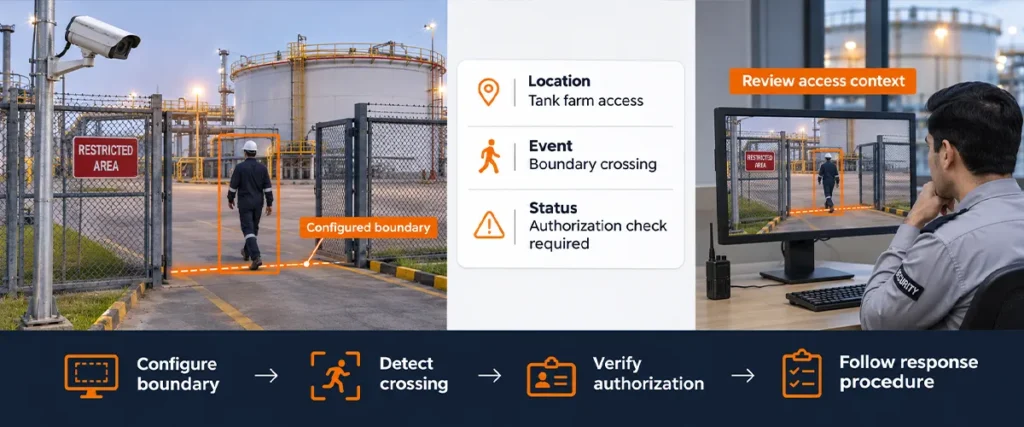
- Perimeter monitoring: Detecting people crossing configured virtual boundaries.
- Restricted-area detection: Identifying unauthorized presence in designated zones.
- After-hours monitoring: Highlighting movement during specified time periods.
- Asset-area surveillance: Monitoring activity around storage tanks and critical installations.
AI intrusion detection for oil and gas can alert security personnel when someone enters a protected area without authorization. Operators can then review the footage and determine the appropriate response.
Managing Multiple Facilities Through Centralized Monitoring
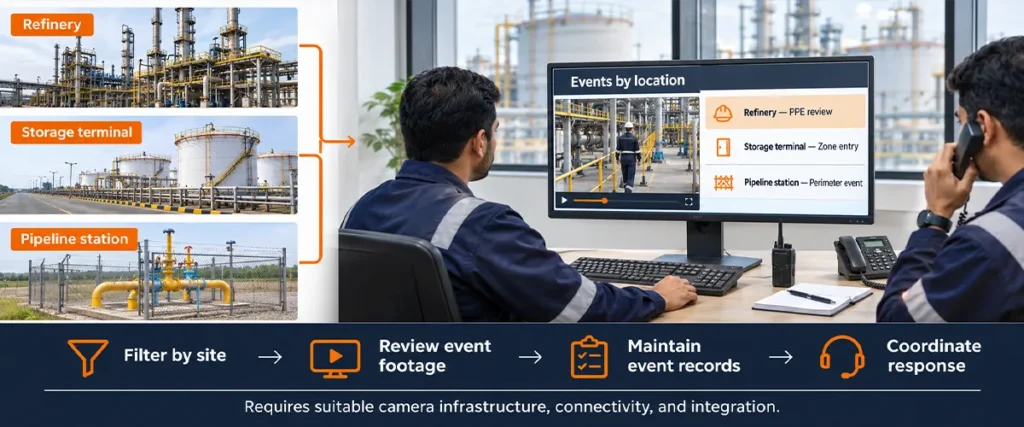
Organizations operating multiple refineries, terminals, and processing plants need consistent visibility across locations. AI video analytics can bring selected alerts and camera feeds into a central monitoring environment.
This can help teams:
- Review events across connected facilities.
- Filter alerts by location and event type.
- Maintain records for incident investigation.
- Coordinate security and safety responses.
- Identify recurring operational concerns.
Implementation depends on camera infrastructure, network connectivity, and system integration requirements.
How Intozi and Ikshana Support Oil & Gas Operations
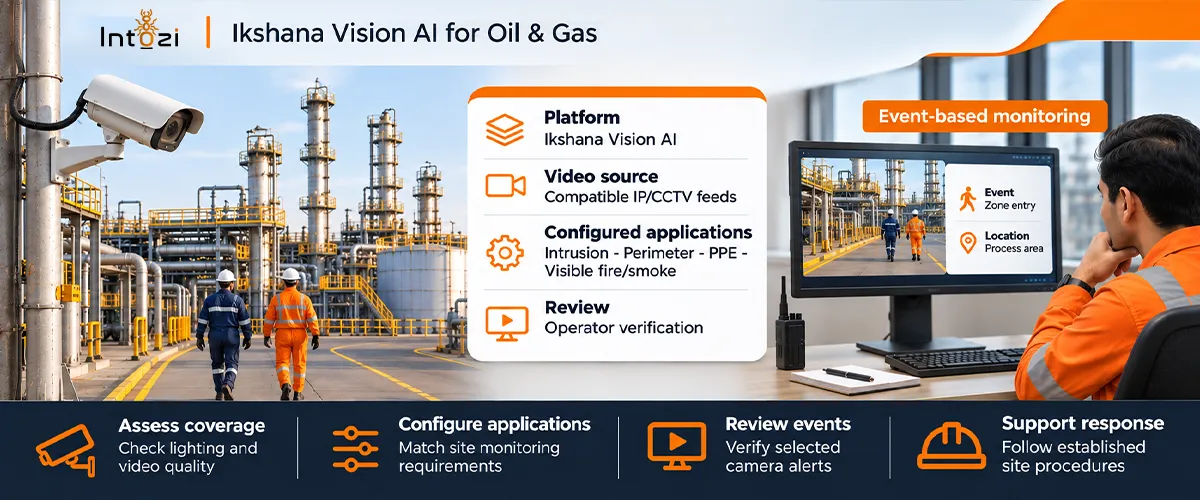
Intozi‘s Ikshana Vision AI Platform supports video analytics applications across industrial environments, including oil and gas facilities. Depending on deployment requirements, it can support configured applications such as intrusion detection, perimeter monitoring, PPE detection, and visible fire or smoke detection.
By analyzing compatible feeds from existing IP/CCTV infrastructure and highlighting selected events, Ikshana can help organizations move towards event-based monitoring and reduce dependence on continuous manual observation. Effective deployment requires assessment of camera coverage, lighting, video quality, and the facility’s specific monitoring requirements.
Frequently Asked Questions (FAQs)
AI video analytics can identify configured events across supported camera feeds and send alerts to operators. This allows teams to focus on relevant incidents rather than watching every camera continuously. Intozi’s Ikshana platform supports this event-based monitoring approach for suitable industrial environments.
Yes, existing CCTV cameras may be used if they provide compatible video streams and sufficient image quality. Camera positioning, lighting, resolution, and integration requirements should be assessed before deployment. Intozi’s Ikshana supports suitable camera-based analytics deployments, subject to infrastructure compatibility.
AI video analytics can identify visible smoke and flame patterns when appropriate detection models are configured. Performance depends on camera coverage, environmental conditions, and visibility. Intozi’s Ikshana can support video-based fire and smoke detection as an additional layer alongside dedicated fire safety systems.
AI intrusion detection identifies people entering configured restricted areas or crossing virtual boundaries. Alerts help security personnel review the relevant footage and decide whether intervention is required. Intozi’s Ikshana supports configured intrusion detection applications for suitable oil and gas surveillance environments.
No. AI video analytics automates selected detection tasks but does not replace human judgment, verification, or emergency response. Intozi’s Ikshana helps monitoring teams identify events that need attention while keeping personnel involved in security and safety decisions.
Upgrade Your Operations With Next-Generation AI Video Analytics
Intozi Tech Pvt Ltd
Unit no- 629, 644, 645 Tower B2, Spaze I-Tech Park, Sohna Road Sec 49, Gurgaon, Haryana-122018
MON-FRI 09:00 - 20:00, SAT 10:00 - 14:00