
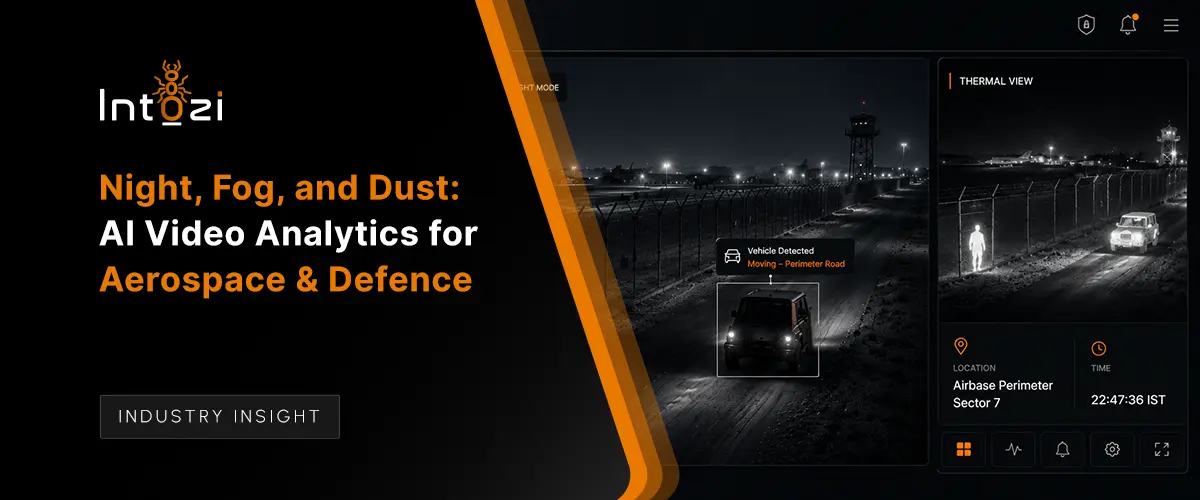
What Can AI Video Analytics See at Night, in Fog, or Through Dust? A Briefing for Aerospace & Defence Sites
Ask any control room supervisor when their cameras are least useful, and the answer is immediate: after sunset and during weather. That gap is the reason AI video analytics for aerospace & defence is judged on degraded footage rather than clean daylight imagery. A system that performs brilliantly at noon and falls apart at 3 a.m. protects nothing, because intruders choose their conditions deliberately and rarely choose favorable ones.
Why Cameras Stop Detecting Properly After Dark
Ordinary cameras work by capturing reflected light. When the light goes, the image breaks down into grain rather than detail, and any software reading that feed can only work with what the camera gives it. Infrared illuminators help over short distances, but they attract insects that trigger alerts across the fence line all night.
What this looks like operationally:
- Effective detection distance collapses to a fraction of daytime range
- Sensor noise registers as motion, flooding the alert queue
- Rules built on colour or clothing description stop functioning
- Wet tarmac, headlights and reflections generate objects that do not exist
The perimeter is still being recorded. It is no longer being watched.
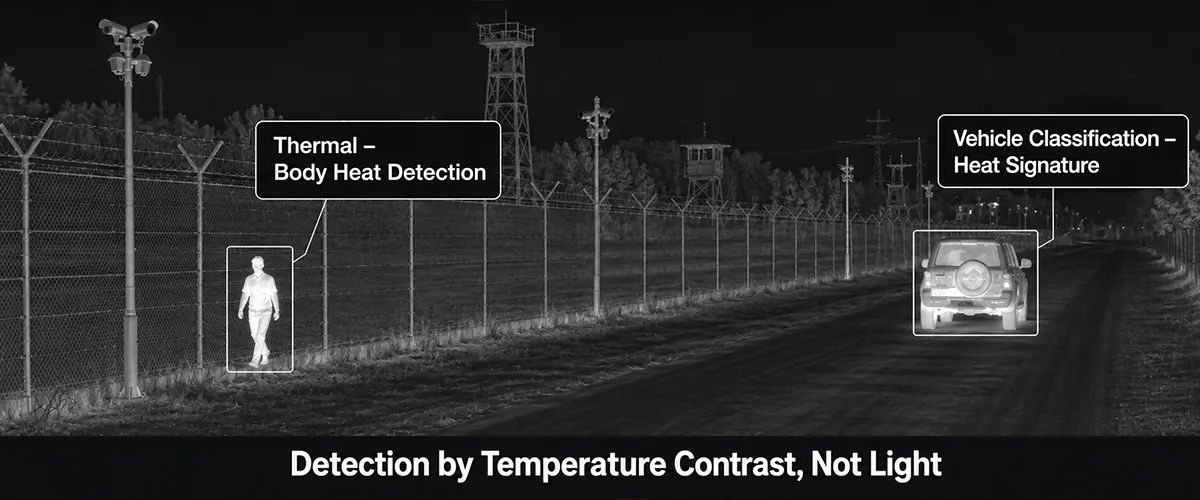
Thermal cameras ignore light completely and detect body heat instead. A person is several degrees warmer than the soil, concrete and vegetation around them, so they stand out clearly whether the site is floodlit or pitch dark. Detection depends on the temperature difference rather than brightness, which turns the usual night-time disadvantage on its head.
Contrast can briefly narrow at sunrise and sunset, as surfaces catch up to ambient temperature, but this window is short and predictable, not a blind spot like fog or dust.
Night surveillance defence deployments gain a structural advantage from this:
- Classification of people and vehicles continues through total darkness
- Thermal contrast frequently peaks in the coldest pre-dawn hours
- Ordinary dark clothing and camouflage offer no cover, because body heat still shows
- Standoff detection ranges hold up rather than collapsing
The trade is detailed. Thermal video analytics defence confirms that a person is approaching and where they are heading, but carries no colour, no facial features, and no readable text.
How AI Video Analytics Performs in Fog and Heavy Rain
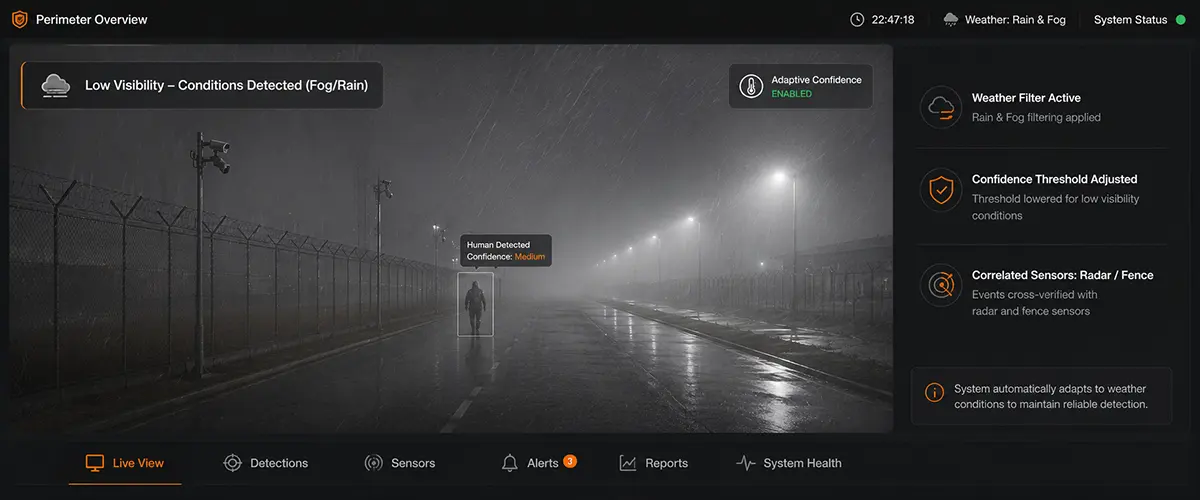
Water droplets scatter energy across the spectrum, so dense fog shortens the effective reach of every optical sensor, including thermal. Genuine AI video analytics low visibility performance keeps producing credible detections from a poor image while refusing to alarm on the weather itself, rather than pretending conditions have no effect.
That behavior comes from specific engineering choices:
- Training data drawn from noisy, rain-streaked, and low-contrast footage
- Rain and snow are recognized as weather and filtered out, not treated as movement
- Confidence thresholds that shift automatically as visibility degrades
- Correlation with radar or fence sensors so weak signals combine into one strong alert
How Dust Storms and Smoke Affect Camera Detection
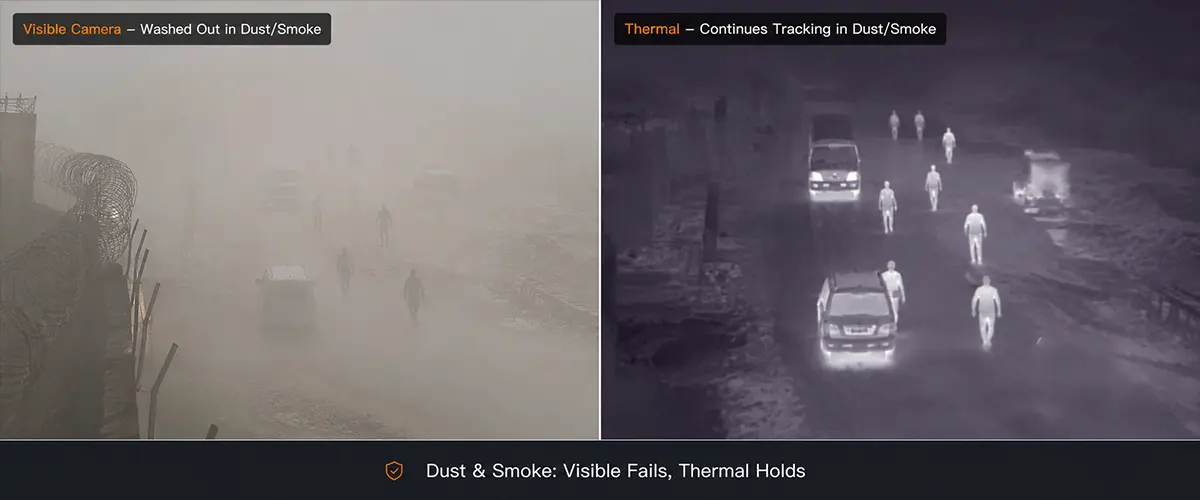
Dust particles block ordinary light far more than they block heat, which is why visible cameras wash out during a dust storm while IR video analytics keeps picking up shapes and movement. Smoke behaves the same way, so thermal continues tracking people and heat sources long after normal footage has become unusable.
For installations across northern India, this is a seasonal certainty rather than an edge case. A perimeter specified entirely with visible-spectrum cameras will have several predictable weeks each year of substantially reduced coverage.
Why Thermal and Visible Cameras Work Better Together
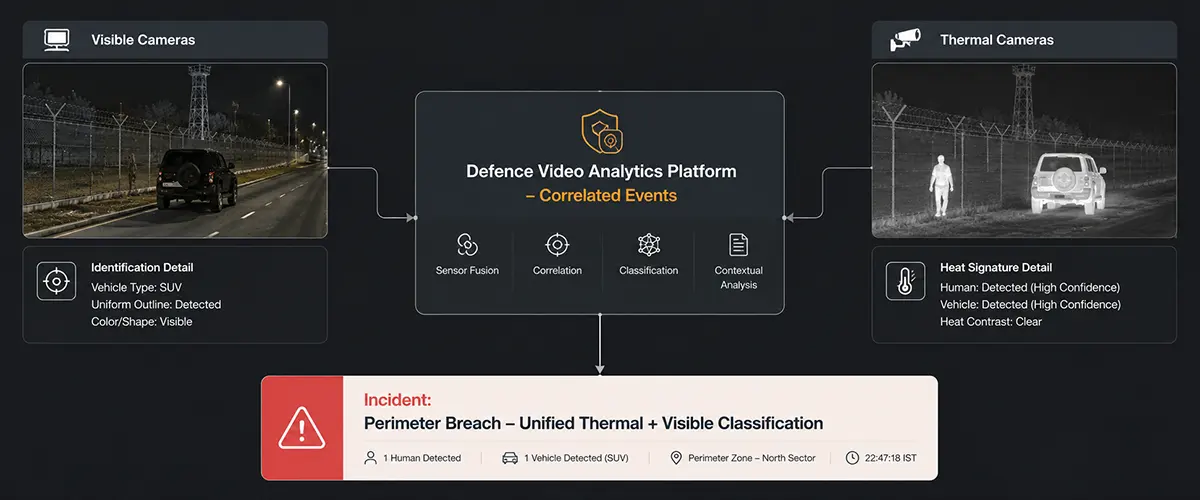
No single sensor answers every question. Thermal establishes that something warm is moving and where. Visible cameras supply identification detail once the target enters an illuminated zone. A well-built defence video analytics platform runs classification across both streams and correlates them, so a single approach produces one incident rather than two disconnected alarms.
Do You Need to Replace Your Existing Cameras?
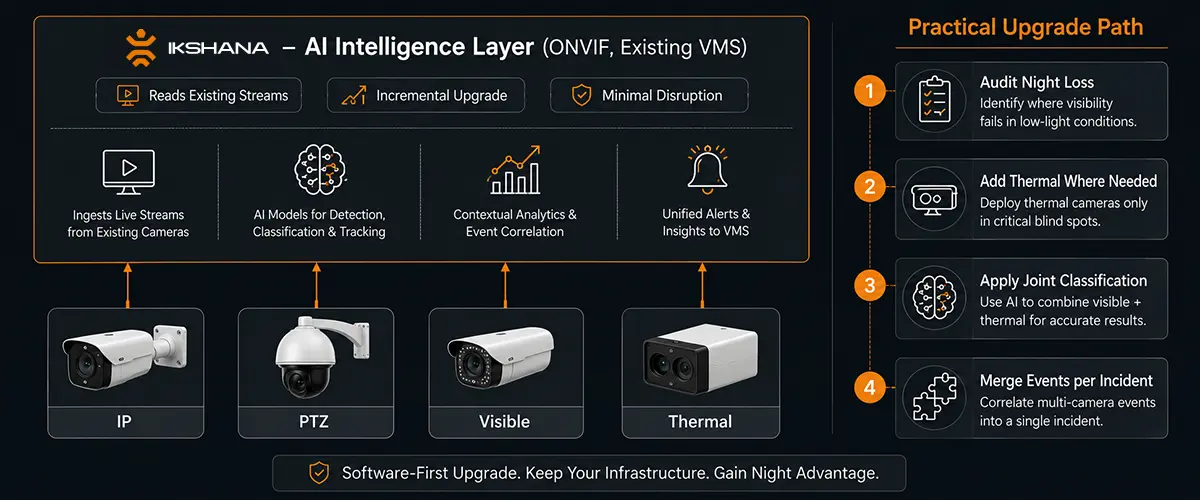
Most sites already own substantial camera infrastructure, and the sensible upgrade path adds intelligence rather than hardware. Intozi’s Ikshana platform reads ONVIF-compliant IP, PTZ, and thermal streams alongside existing video management systems, which keeps the change incremental and the disruption contained.
A realistic sequence:
- Audit which cameras lose usable detection after dark, and under which conditions
- Introduce thermal units only at segments where that loss creates real exposure
- Apply classification across visible and thermal feeds under one interface
- Merge correlated events so operators receive one notification per incident
What to Check Before Trusting a Low-Light Performance Claim
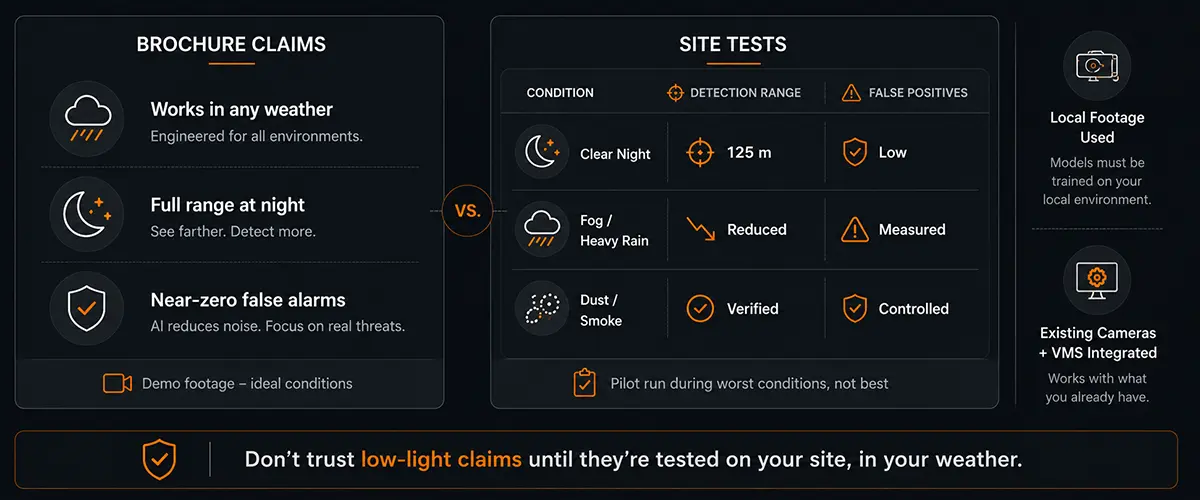
Low-visibility capability is trivially easy to claim and genuinely difficult to verify, which makes vendor evidence the weakest part of most procurement processes. Buyers assessing AI surveillance for defence sector projects should insist on measurements taken in their own conditions rather than accepting a controlled demonstration.
Request specifically:
- A pilot scheduled during your worst weather, not your clearest week
- Detection range quoted separately for clear, rain, fog and dust conditions
- False-positive counts across a full weather cycle rather than a monthly average
- Confirmation that models can be retrained on local footage and terrain
- Integration detail covering your current cameras and VMS
Local adaptation matters more than sensor specification. Models trained in other regions consistently misread Indian livestock, monsoon conditions and seasonal dust, and better cameras will not fix a system that has never seen your environment.
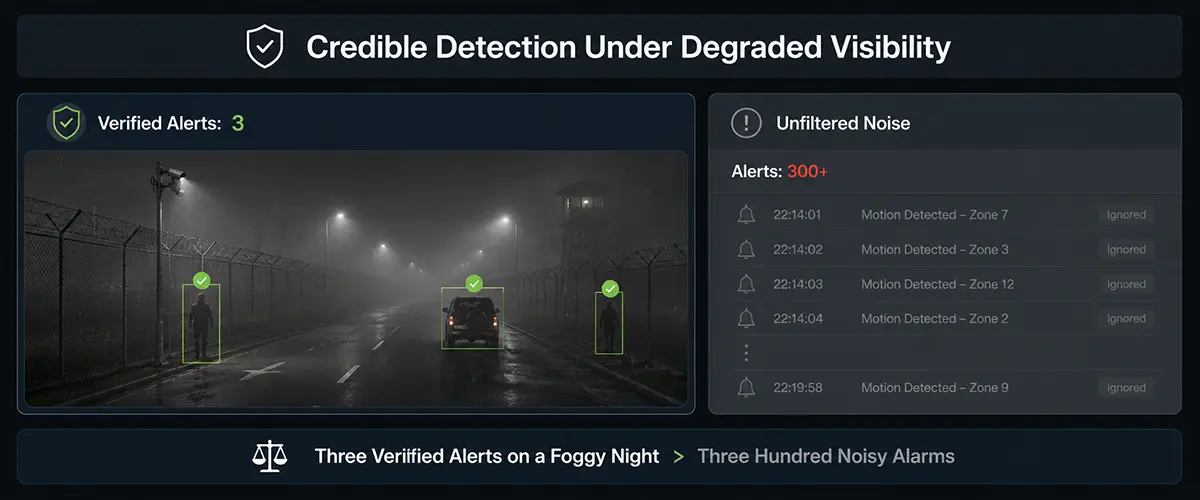
Nobody controls the weather, and no analytics layer removes its effects. The achievable goal is narrower and more valuable: keep detection credible as conditions deteriorate, and keep the alert stream small enough that operators still act on it. Three verified alerts on a foggy night deliver more security than three hundred that nobody opens.
This is the standard Intozi builds toward. Ikshana combines classification across thermal and visible feeds with integration into surveillance infrastructure that sites already own, so aerospace and defence teams retain reliable detection through darkness, fog, rain, and dust while keeping alert volumes at a level operators can genuinely work with.
Frequently Asked Questions (FAQs)
Upgrade Your Operations With Next-Generation AI Video Analytics
Intozi Tech Pvt Ltd
Unit no- 629, 644, 645 Tower B2, Spaze I-Tech Park, Sohna Road Sec 49, Gurgaon, Haryana-122018
MON-FRI 09:00 - 20:00, SAT 10:00 - 14:00