
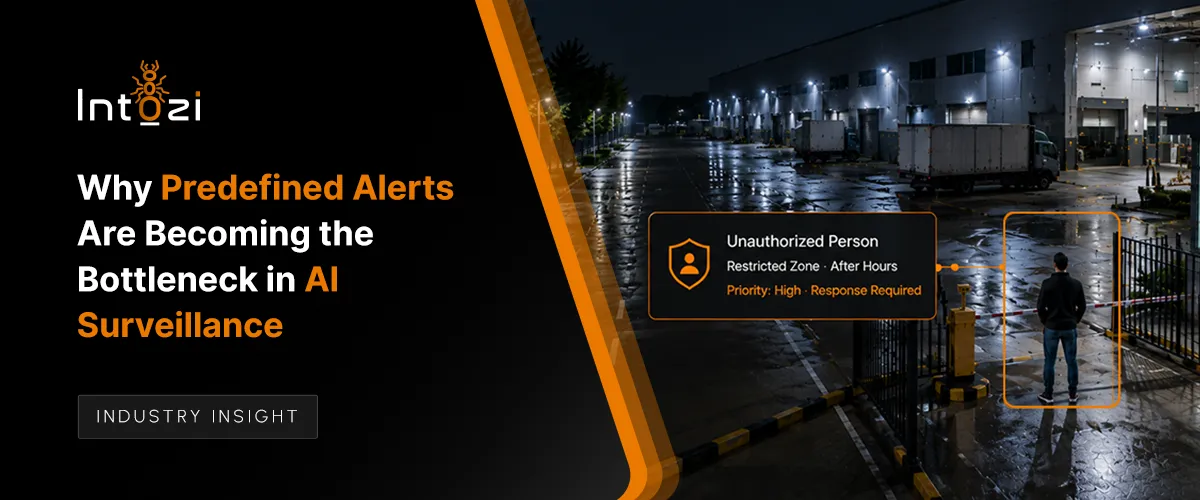
Why Predefined Alerts Are Becoming the Bottleneck in AI Surveillance
Security teams today manage more video than ever. Cameras cover entrances, warehouses, production floors, parking areas, restricted zones, and public spaces, creating a constant flow of visual information.
The challenge is that more video does not automatically mean better security.
Many organizations still depend on predefined alerts such as motion detection, line crossing, or restricted-area entry. While these rules can identify specific events, they often struggle to understand what those events actually mean.
A person entering a restricted zone could be an employee, a maintenance worker, or an unauthorized visitor. A vehicle parked in one location could be normal during business hours but unusual after hours.
This is where AI security surveillance can add intelligence to existing video infrastructure. AI-powered video analytics can help organizations identify relevant activities and focus on events that require attention.
Why Predefined Alerts Fall Short
Predefined alerts work according to conditions configured in advance. When a condition occurs, a notification is generated, which works well for simple situations but creates two problems as deployments scale.
First, volume: applying the same rules across hundreds of cameras quickly produces repeated notifications from routine activity, false positives, and important incidents lost among low-value alerts.
Second, context: a single visual trigger often isn’t enough to understand what’s actually happening. A person entering a restricted area may be an employee, a maintenance worker, or an unauthorized visitor. A vehicle parked in one location may be normal during business hours but unusual after hours. The rule fires the same way either way. It just doesn’t have enough information to tell the difference.
This is where intelligent surveillance software can add the missing layer: analyzing people, vehicles, objects, activities, and locations to identify events based on specific organizational requirements, rather than relying on isolated triggers alone.
How AI Makes Video Monitoring More Intelligent
AI video surveillance software adds an intelligence layer to video infrastructure using computer vision and AI models. Instead of asking only “did something move?”, it can identify people, vehicles, objects, activities, and other visual conditions. Depending on the use case, that means detecting restricted-area activity, loitering, abandoned objects, crowd activity, fire and smoke, PPE violations, perimeter events, and safety violations.
This changes what teams can ask: What happened? Where did it happen? Is it unusual? Does someone need to respond?
This shift also addresses a problem that grows with scale: when teams receive large volumes of routine notifications, manually reviewing every event becomes difficult, and over time, alert fatigue can make important incidents harder to identify. By focusing on specific objects, activities, locations, and conditions, AI-powered analytics support better alert prioritization, less repetitive manual review, more efficient use of security personnel, and improved situational awareness. The goal isn’t more alerts; it’s alerts worth acting on.
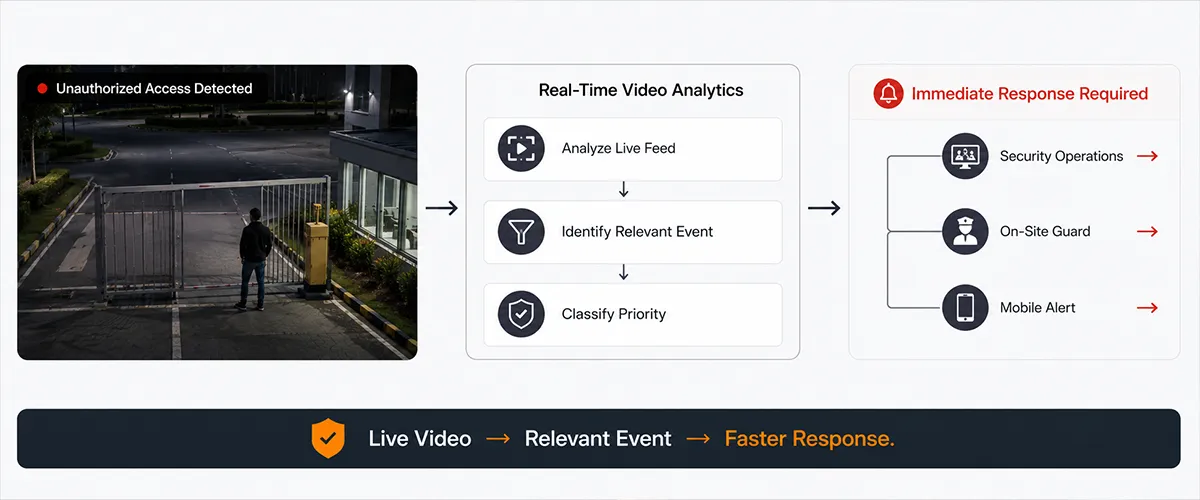
What Is Real-Time Video Analytics?
Real-time surveillance analytics allows organizations to analyze live video feeds and identify relevant events as they happen.
This is particularly valuable when teams need to respond quickly to situations such as:
- Unauthorized access
- Restricted-zone entry
- Fire or smoke
- Safety violations
- Traffic incidents
- Abandoned objects
- Perimeter breaches
Instead of requiring personnel to continuously watch multiple screens, AI can analyze video streams and highlight specific events automatically.
This can improve response time while reducing routine manual monitoring.
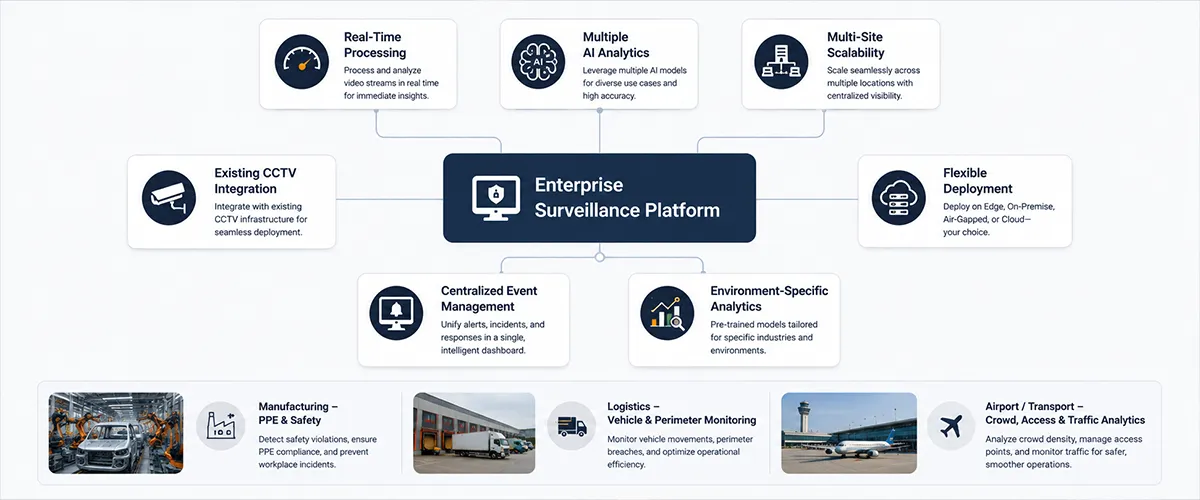
What Should Enterprises Look for in Enterprise Surveillance Software?
Large organizations often have different requirements across facilities and departments.
A manufacturing plant may need PPE and worker-safety monitoring, while a logistics facility may require vehicle and perimeter analytics. Airports and transportation facilities may have requirements around crowds, access, and traffic.
This makes enterprise surveillance software more than a basic alerting system.
Organizations should consider:
- Real-time processing
- Multiple AI analytics capabilities
- Scalability across locations
- Integration with existing infrastructure
- Flexible deployment
- Centralized event management
- Support for different use cases
The platform should allow organizations to apply different analytics based on the environment rather than relying on identical rules everywhere.
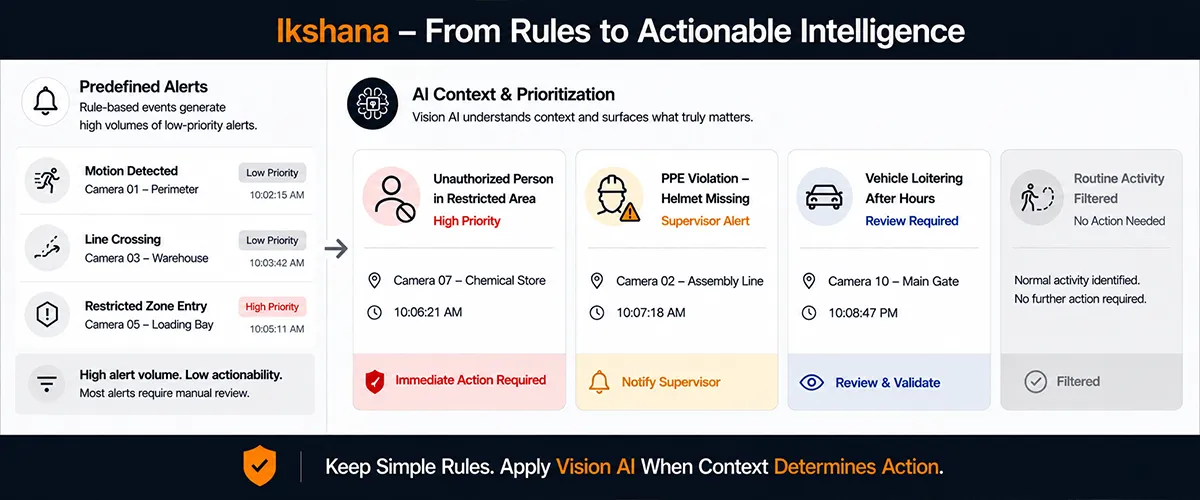
How Ikshana Helps Move Beyond Predefined Alerts
Smart surveillance software does more than notify someone that an event occurred. It provides relevant information about the event, helping teams understand what action may be required. Organizations can keep predefined rules for simple conditions while applying AI analytics where context matters more.
Ikshana by Intozi is an AI-powered video analytics platform that transforms existing video infrastructure into a real-time intelligence layer.
It supports computer vision and analytics across security, safety, traffic, manufacturing, logistics, smart cities, and enterprise environments.
Ikshana can analyze video feeds in real time and identify specific events and operational conditions.
Its applications include:
- Real-time event detection
- Security and safety monitoring
- People and vehicle analytics
- Restricted-area monitoring
- Compliance monitoring
- Traffic and road-safety analytics
- Automated event notifications
- Actionable video intelligence
This enables organizations to build video analytics around their operational requirements while continuing to use suitable existing infrastructure.
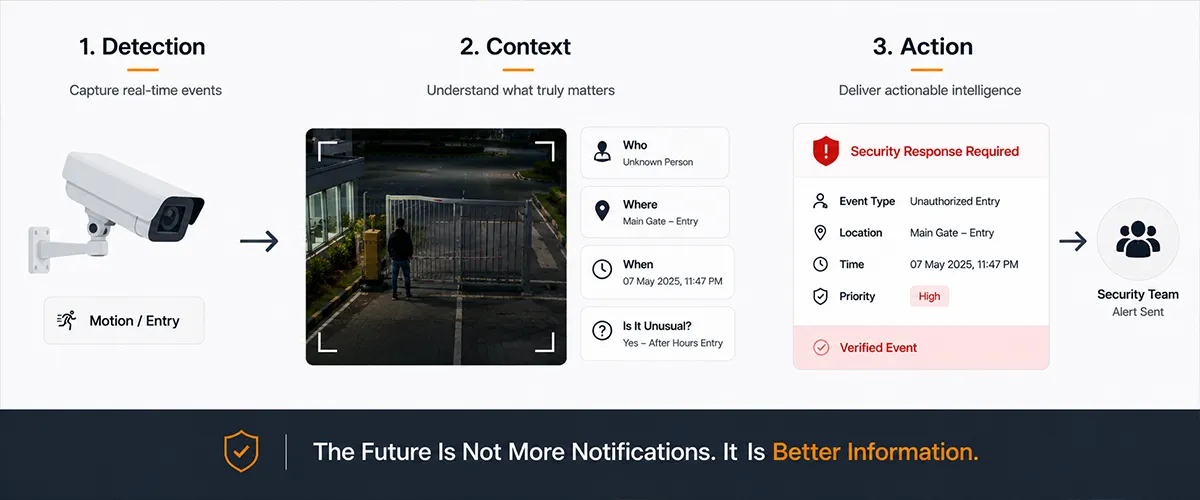
The Future of AI-Powered Video Intelligence
The future is not about generating more notifications. It is about generating better information.
Predefined rules will remain useful for simple and clearly defined conditions. However, complex environments require technology that can understand more than a single trigger.
AI-powered video analytics can bridge this gap by continuously analyzing visual information and identifying relevant events.
The shift is from
Detection → Context → Action
For organizations looking to turn existing video infrastructure into real-time intelligence, Intozi provides AI-powered video analytics through Ikshana, supporting security, safety, traffic, manufacturing, logistics, smart cities, and enterprise use cases.
Frequently Asked Questions (FAQs)
Predefined alerts work well for simple conditions but may not understand the context behind an event. When used across large video environments, they can create repetitive notifications and false positives.
AI can analyze people, vehicles, objects, activities, and specific areas instead of relying only on basic motion triggers. This helps create more targeted detection workflows and reduce unnecessary notifications.
AI video analytics uses computer vision and artificial intelligence to analyze video feeds and identify specific events, objects, people, or activities. It helps organizations use video for real-time monitoring and decision-making.
Yes, AI analytics can often work with suitable existing camera infrastructure when compatible video streams and technical requirements are available. Camera quality, video protocols, network capacity, and processing requirements should be evaluated before deployment.
Businesses should consider real-time processing, scalability, analytics capabilities, integration options, deployment flexibility, and compatibility with existing infrastructure. The platform should also support different use cases as requirements change.
Yes. AI video analytics can support workplace safety, traffic management, manufacturing, logistics, people analytics, compliance, and facility operations, allowing organizations to gain more value from their existing video infrastructure.
Real-time analytics helps organizations identify important events while they are happening instead of relying only on manual review afterward. This can support faster responses to unauthorized access, safety violations, fire or smoke, and other time-sensitive events.
AI does not have to replace predefined rules. Organizations can continue using fixed rules for simple conditions while applying AI analytics to situations that require greater visual understanding and context.
Ikshana by Intozi analyzes video streams and converts visual information into real-time intelligence. It supports security, safety, traffic, manufacturing, logistics, smart cities, and enterprise applications, helping organizations move beyond basic alerts toward actionable insights.
Upgrade Your Operations With Next-Generation AI Video Analytics
Intozi Tech Pvt Ltd
Unit no- 629, 644, 645 Tower B2, Spaze I-Tech Park, Sohna Road Sec 49, Gurgaon, Haryana-122018
MON-FRI 09:00 - 20:00, SAT 10:00 - 14:00