
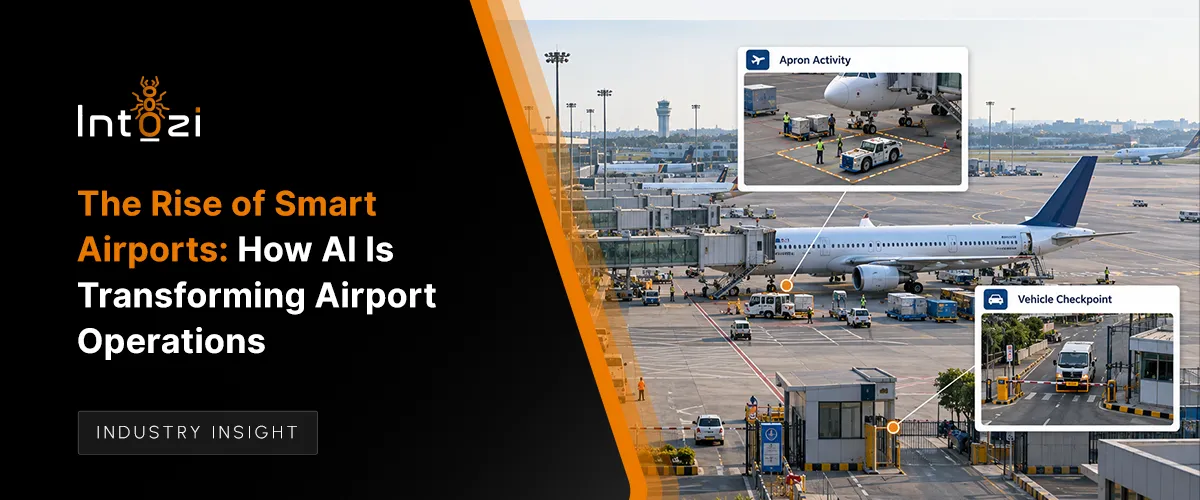
The Rise of Smart Airports: How AI Is Transforming Airport Operations
Airports are among the most complex operational environments, bringing together passenger movement, aircraft activity, ground vehicles, baggage handling, and security operations. Coordinating these activities requires continuous awareness across terminals, aircraft stands, service roads, and restricted areas. Traditional surveillance provides valuable visual coverage, but identifying important events across numerous video feeds can be challenging. AI video analytics for airports adds an analytical layer that helps identify configured events, improve situational awareness, and support more informed operational decisions, as airports work toward safer, more efficient operations.
How AI Video Analytics Is Changing Airport Operations
AI video analytics uses computer vision to analyze video streams and recognize defined objects, movements, and events. In an airport environment, these capabilities can support operational visibility across passenger areas, airside operations, vehicle access points, and security-sensitive locations.
Depending on the analytics deployed, applications span passenger flow, apron and ground operations, vehicle movement, restricted-area security, and incident investigation, each covered below.
These capabilities help airport teams move beyond continuously watching video feeds toward reviewing relevant events and acting according to established procedures.
Key AI Video Analytics Use Cases in Smart Airports
1. Airport Queue Monitoring and Passenger Flow Analysis
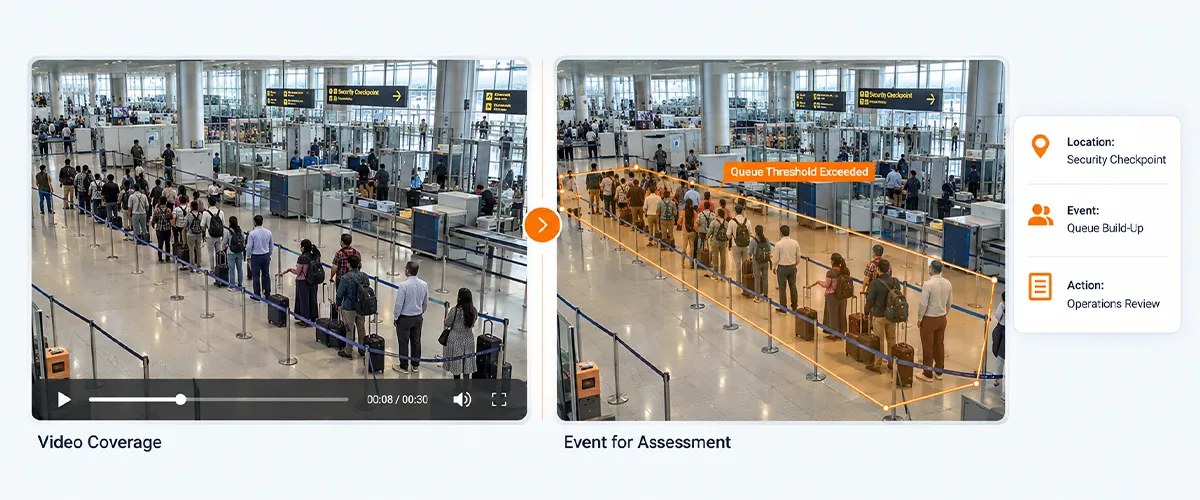
Airport queue monitoring assesses configured areas such as check-in counters, security checkpoints, and boarding gates for queue length, crowd density, and changes in passenger movement. These insights support staffing and crowd-management decisions, though accuracy depends on camera coverage and conditions.
2. Apron Safety Monitoring and Ground Operations
Aircraft aprons bring together aircraft, ground support equipment, vehicles, and personnel in close proximity. Apron safety monitoring can flag people entering aircraft movement zones, vehicles moving into marked safety areas, and unsafe interactions between personnel and vehicles. Alerts should complement trained supervision and established airside safety systems.
3. Aircraft Turnaround Monitoring
Aircraft turnaround monitoring improves visibility into activities around aircraft stands, such as vehicle and equipment movement and configured access events. It shows observable activity but does not confirm task completion or aircraft readiness, which still need operational systems and human verification.
4. Airport ANPR Solutions and Ground Vehicle Monitoring
Airport ANPR solutions read vehicle number plates at suitable camera locations, supporting entry and exit records and configured verification workflows. Results depend on camera positioning and plate visibility, and ANPR should complement airport access-control policies.
5. Restricted-Area and Perimeter Security
Airport security solutions must help personnel maintain awareness across boundaries, access points, and service corridors. AI-enhanced airport surveillance solutions add event recognition to compatible video feeds, flagging people entering restricted zones, vehicles crossing virtual boundaries, and selected perimeter intrusion events.
6. Incident Investigation
Airport CCTV analytics associates configured events with relevant footage, timestamps, and camera locations, reducing the effort of reviewing multiple cameras after an incident. Search capabilities depend on the platform and its configuration.
Airports generate substantial volumes of CCTV footage. Finding a specific event may require personnel to review multiple cameras and time periods, especially when an incident involves several locations.
Why Airports Need More Than Traditional Surveillance
Traditional surveillance is essential for visual coverage, but its value depends partly on how quickly personnel can identify and interpret relevant activity.
AI video analytics adds a layer of event recognition that can help teams focus on specific operational requirements. Rather than treating every camera feed equally, airport teams can configure analytics around priority areas and defined event types.
The potential benefits include:
- Improved situational awareness: Identify configured events across selected areas.
- More focused reviews: Direct personnel towards the activity that may require attention.
- Better operational visibility: Analyze passenger, vehicle, and ground activity where suitable analytics are deployed.
- More structured incident investigation: Use available event records and relevant footage to support reviews.
- Data-informed planning: Use suitable historical observations to understand recurring congestion or activity patterns.
These benefits depend on selecting appropriate use cases, maintaining suitable camera coverage, and establishing clear alert-handling workflows.
How to Implement AI Video Analytics at an Airport
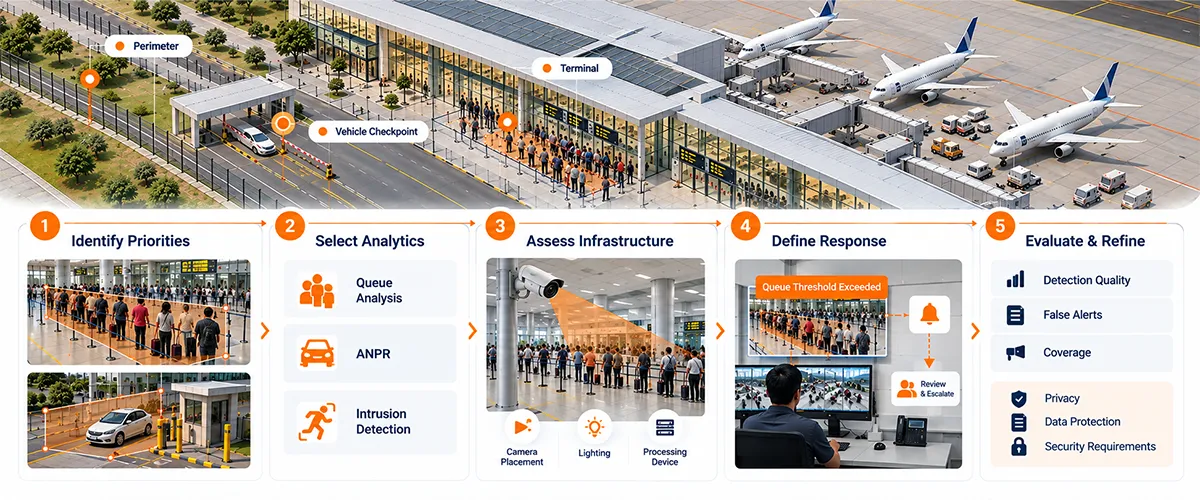
A successful deployment starts with operational requirements rather than selecting analytics simply because they are available. This structured approach helps align airport video analytics with measurable operational needs.
- Identify priority operational areas.
- Select the appropriate video analytics or use cases.
- Assess video and infrastructure requirements
- Define alert and escalation workflows.
- Evaluate performance against operational objectives
How Intozi and Ikshana Support Smart Airport Operations
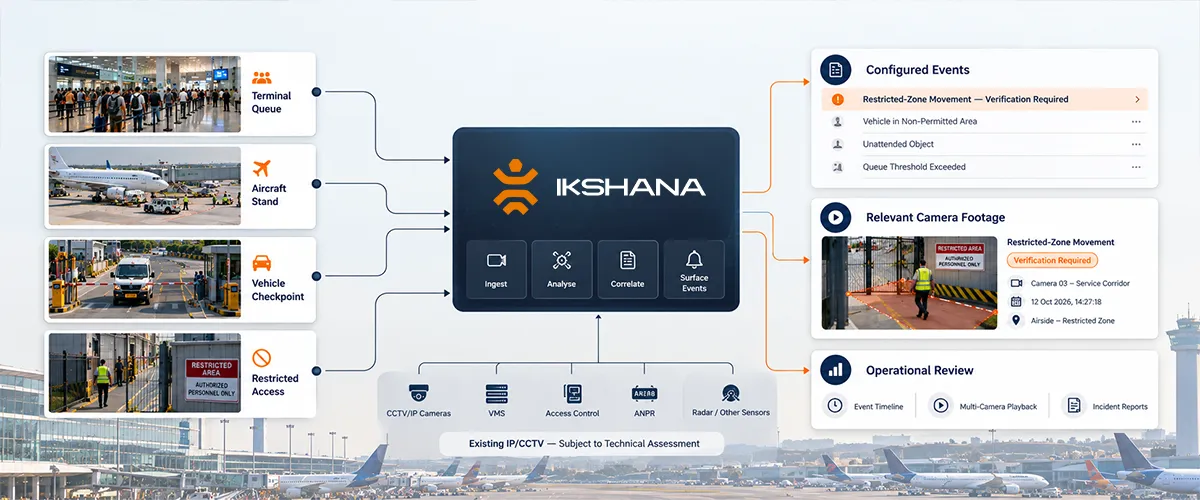
Intozi’s Ikshana Vision AI Platform is an AI-powered video intelligence platform that adds analytics to existing IP/CCTV infrastructure. For suitable airport deployments, selected analytics can support operational safety, restricted-area monitoring, passenger movement, and vehicle activity. Specific capabilities depend on the analytics deployed, camera coverage, and system integrations, and a deployment assessment helps determine which use cases fit existing airport workflows.
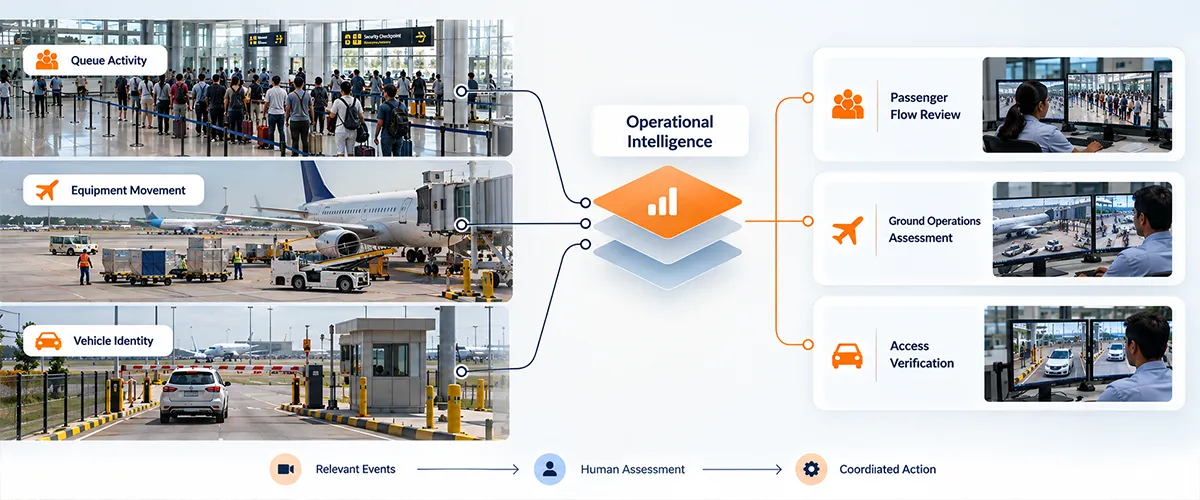
The Future of Smart Airports: From Video Monitoring to Operational Intelligence
Smart airports need more than video coverage. They need ways to identify relevant activity and help personnel respond appropriately. AI video analytics from Intozi supports passenger flow analysis, apron safety monitoring, aircraft turnaround visibility, vehicle identification, and restricted-area security in AI-powered airport operations. For operators evaluating airport operational intelligence, the next step is to identify priority use cases and connect event detection with meaningful action. Ikshana supports this approach, helping organizations turn visual data into actionable information while supporting human assessment and established airport procedures.
Frequently Asked Questions (FAQs)
AI video analytics for airports uses computer vision to analyze video feeds and identify configured events involving people, vehicles, movement, or activity in designated areas. Depending on the deployment, it can support passenger flow analysis, airport safety monitoring, vehicle identification, restricted-area security, and incident investigation.
Airport queue monitoring can help identify queue build-up, changes in crowd density, and congestion in selected terminal areas. These insights can help airport teams assess whether staffing adjustments or crowd-management measures are needed. Results depend on the analytics used and the conditions within each monitored area.
Aircraft turnaround monitoring provides visibility into selected activities around an aircraft between arrival and departure. Video analytics can help observe ground vehicle movement, equipment activity, and configured access events around aircraft stands. It complements operational systems and personnel responsible for confirming task completion and aircraft readiness.
Airport ANPR solutions use cameras and recognition software to read vehicle number plates at suitable locations. The resulting information can support entry and exit records, vehicle identification, and configured verification workflows, subject to image quality, local plate formats, and system integration requirements.
Airport surveillance provides video coverage for observation and investigation. Airport CCTV analytics adds software-based analysis that can identify predefined events, generate alerts, and help locate relevant footage. The capabilities available depend on the platform, analytics configuration, and video infrastructure.
Yes. Depending on the deployed analytics, AI video analytics can help flag movement into restricted zones, selected perimeter events, and activity around designated access points. It complements physical security, access control, screening, patrols, and established response procedures.
Potentially, yes. Existing cameras may be suitable when their video quality, resolution, placement, connectivity, and other technical characteristics meet the requirements of the selected analytics. A technical assessment is needed to determine compatibility and any additional infrastructure requirements.
Airport ground operations monitoring can use video analytics to observe selected activities around aircraft stands, service roads, ground support equipment, and other operational areas. Configured detections can help teams identify events that warrant review and improve visibility into ground activity without replacing trained supervision.
Airports should define priority use cases, assess camera coverage and image quality, select suitable analytics, establish alert-handling procedures, and evaluate performance against operational objectives. Privacy, data protection, cybersecurity, and airport-specific regulatory requirements should also be considered.
Upgrade Your Operations With Next-Generation AI Video Analytics
Intozi Tech Pvt Ltd
Unit no- 629, 644, 645 Tower B2, Spaze I-Tech Park, Sohna Road Sec 49, Gurgaon, Haryana-122018
MON-FRI 09:00 - 20:00, SAT 10:00 - 14:00