
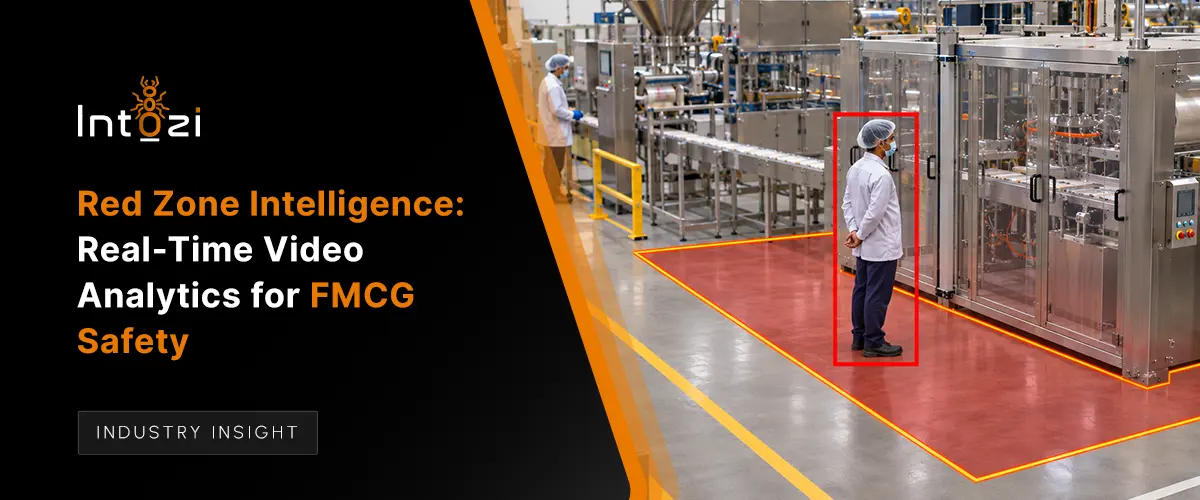
Red Zone Intelligence: AI Video Analytics for FMCG Manufacturing Safety
Fast-moving consumer goods (FMCG) manufacturing facilities handle continuous production, packaging, storage, and material movement. These environments require strict safety and hygiene practices, particularly in restricted production zones where even minor violations can affect worker safety and product quality. AI video analytics for FMCG manufacturing can help organizations identify selected safety and operational events through real-time camera analysis, reducing dependence on continuous manual observation.
Why FMCG Manufacturing Facilities Need Real-Time Safety Monitoring
FMCG plants involve multiple activities taking place simultaneously across production lines, packaging areas, warehouses, and processing zones. Manual supervision alone can make it difficult to identify every safety or hygiene-related violation.
Common challenges include:
- Restricted-zone violations: Employees or visitors entering areas without proper authorization.
- PPE non-compliance: Workers operating without required helmets, masks, gloves, or protective clothing.
- Hygiene violations: Personnel not following designated hygiene procedures in monitored areas.
- Unsafe movement: Forklifts and employees operating in shared spaces.
- Delayed incident identification: Safety teams may not immediately notice violations across multiple camera feeds.
Real-time video analytics can help address these challenges by identifying configured events and notifying responsible personnel.
How AI Video Analytics Identifies Safety Risks in FMCG Plants
AI safety monitoring for FMCG manufacturing uses computer vision models to analyse compatible camera feeds and identify predefined visual events. Instead of relying entirely on operators watching multiple screens, the system can highlight activities that require attention.
Key applications include:
- PPE detection: Identifying missing or incorrectly worn safety equipment where visible.
- Restricted-area monitoring: Detecting unauthorised entry into designated zones.
- Fall detection: Identifying potential personnel falls in suitable camera views.
- Unsafe movement detection: Monitoring selected interactions between workers and vehicles.
- Crowd monitoring: Identifying unusual crowding in configured operational areas.
Alerts help safety teams investigate potential violations and take appropriate action. Detection accuracy depends on camera placement, lighting, visibility, and model configuration.
Understanding Red Zone Intelligence in FMCG Manufacturing
Red zones are designated high-risk or restricted areas within manufacturing facilities. These may include processing sections, automated machinery zones, chemical handling areas, and locations where access must be controlled.
AI video analytics solutions for FMCG manufacturing can support red-zone monitoring by identifying configured activities within these areas. Red zone intelligence applies this analysis to high-risk areas, helping safety teams review configured events such as unauthorized entry or missing PPE.
For example, video analytics can help identify:
- Personnel entering restricted zones without authorisation.
- Workers approaching designated hazardous equipment areas.
- Missing PPE in monitored production sections.
- Unusual movement around restricted operational spaces.
- Activities that require review by safety supervisors.
By generating alerts for selected events, organizations can direct attention towards high-risk locations rather than depending solely on routine physical inspections.
Maintaining Hygiene Compliance Across Production Areas
Hygiene is a critical requirement in food, beverage, and consumer goods manufacturing. Production environments often have specific entry procedures, protective clothing requirements, and sanitation practices.
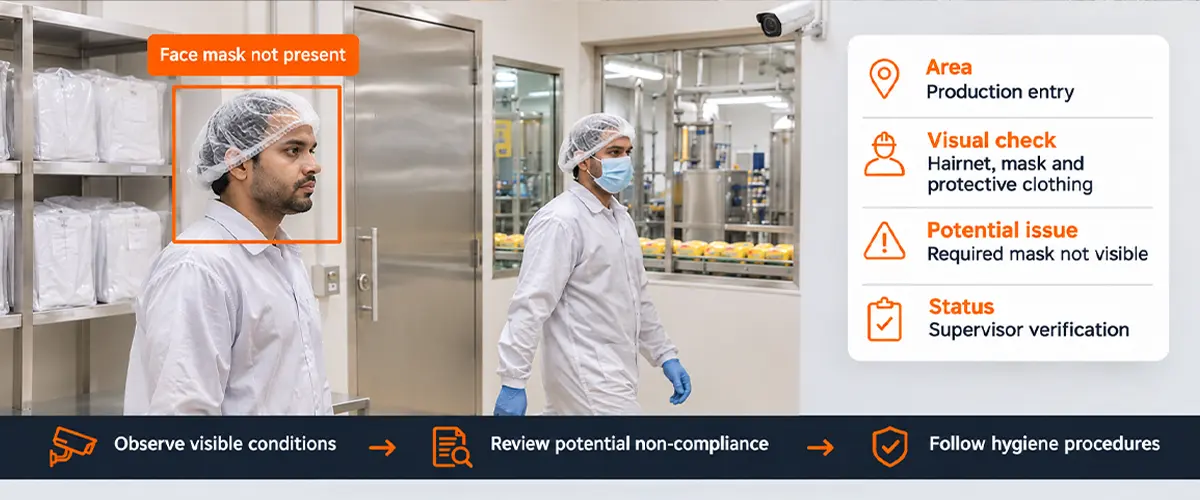
An AI hygiene compliance system for FMCG can support visual checks for predefined hygiene-related conditions.
Depending on the detection models and camera coverage, applications may include:
- Identifying whether workers are wearing required protective clothing.
- Monitoring the use of hairnets, masks, and other visible hygiene equipment.
- Detecting entry into designated hygiene-controlled areas.
- Highlighting potential non-compliance for supervisor verification.
Video analytics cannot independently verify every hygiene requirement, such as proper handwashing technique or microbial contamination. These processes still require appropriate inspection methods, sensors, and established quality-control procedures.
The Role of AI in Improving FMCG Plant Operations
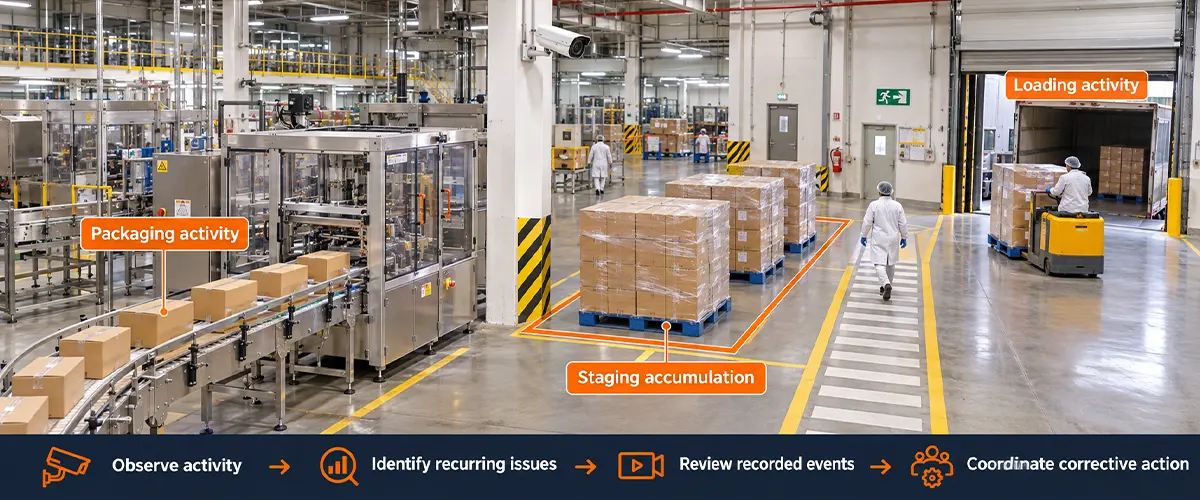
AI in FMCG manufacturing extends beyond safety monitoring. Video analytics can also support operational visibility by identifying selected activities across production and logistics areas.
Potential applications include:
- Monitoring movement around production and packaging lines.
- Identifying congestion in material handling areas.
- Observing loading and unloading activities.
- Monitoring access to restricted operational zones.
- Reviewing selected events through recorded footage.
These insights can help supervisors understand recurring operational issues and coordinate corrective actions.
Centralized Supervision Through FMCG Plant Monitoring Software
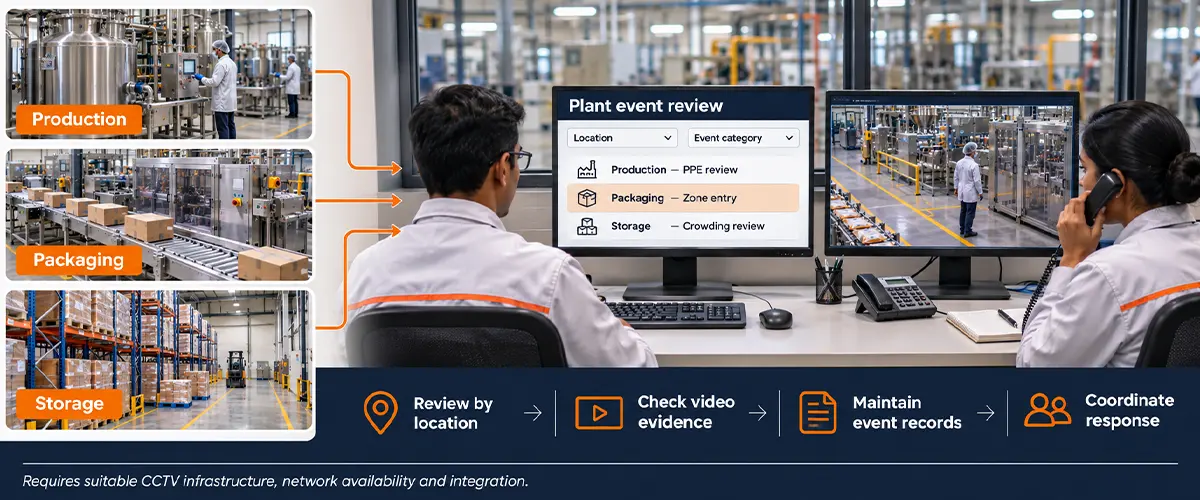
Managing multiple production areas through separate camera feeds can increase the workload for control room operators. FMCG plant monitoring software with integrated video analytics can bring relevant alerts and camera feeds into a centralized interface.
This can support:
- Monitoring multiple production and storage areas.
- Reviewing alerts by location and event category.
- Maintaining video records for incident investigation.
- Coordinating safety and security responses.
- Identifying recurring compliance concerns.
The implementation depends on existing CCTV infrastructure, system integration, network availability, and the facility’s monitoring requirements.
How Intozi and Ikshana Support FMCG Safety Monitoring
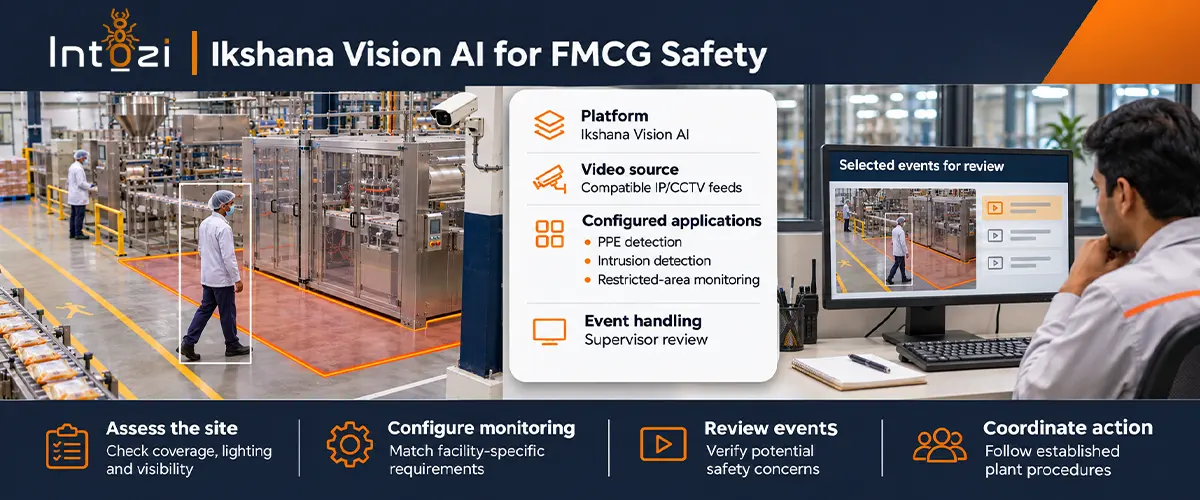
Intozi‘s Ikshana Vision AI Platform supports AI-powered video analytics across industrial environments, including FMCG manufacturing facilities. Depending on deployment requirements, it can support configured applications such as PPE detection, intrusion detection, restricted-area monitoring, and other visual safety analytics.
By analyzing compatible IP/CCTV camera feeds and highlighting selected events, Ikshana can help organizations improve visibility across production environments and direct attention towards potential safety and security concerns. Deployment can be aligned with facility-specific monitoring requirements.
Frequently Asked Questions (FAQs)
AI video analytics can identify configured safety events such as missing PPE, restricted-area entry, and potential falls through compatible camera feeds. This can help safety teams identify situations requiring attention without continuously watching every camera. Intozi’s Ikshana platform supports configurable video analytics applications for suitable FMCG manufacturing environments.
Yes, configured AI models can identify visible PPE-related violations, such as missing helmets, masks, or reflective jackets, depending on camera coverage and detection requirements. Intozi’s Ikshana supports PPE detection applications that can help organizations strengthen visual safety supervision.
AI video analytics can monitor selected visible hygiene requirements, including the use of protective clothing and entry into designated hygiene-controlled areas. It cannot replace all hygiene inspections or verify invisible contamination. Intozi’s Ikshana can support configured visual compliance monitoring as part of a broader hygiene management process.
Red zones are designated areas where access is restricted because of machinery, production hazards, chemicals, or specific operational requirements. AI video analytics can identify configured entry violations and alert supervisors. Intozi’s Ikshana supports restricted-area and intrusion detection applications for suitable industrial environments.
Existing CCTV cameras may support AI analytics if they provide compatible video streams, sufficient resolution, and suitable viewing angles. Lighting, visibility, and integration requirements should also be assessed. Intozi’s Ikshana can work with suitable camera infrastructure, depending on deployment requirements.
Upgrade Your Operations With Next-Generation AI Video Analytics
Intozi Tech Pvt Ltd
Unit no- 629, 644, 645 Tower B2, Spaze I-Tech Park, Sohna Road Sec 49, Gurgaon, Haryana-122018
MON-FRI 09:00 - 20:00, SAT 10:00 - 14:00