
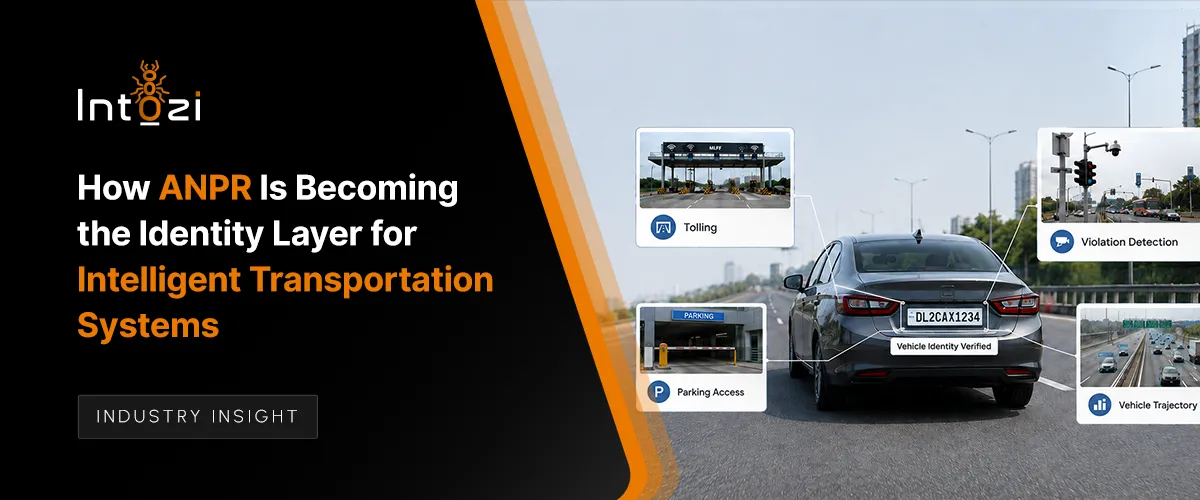
How ANPR Is Becoming the Identity Layer for Intelligent Transportation Systems
A modern city can measure almost everything about its traffic. Detectors count vehicles, radar measures their speed, and cameras track their movement. Yet all that data stays siloed unless one question gets answered: which vehicle was that? Closing that gap is what’s turning ANPR from a narrow point solution into something far bigger, the identity layer underneath every intelligent transportation system. This is the foundation modern ANPR traffic solutions are built on, turning raw vehicle detection into identity that other systems can act on.
Identity is what turns observation into action. Counting thousands of vehicles an hour gives you a statistic. Relating each one to a registration plate gives an insight and helps to govern enforcement. For planners evaluating an intelligent traffic management system, ANPR is fast becoming the component that makes every other module actionable.
Why Vehicle Identity Became the Missing Layer
Most traffic technology was built to measure conditions, not to identify participants. That was fine as long as a human was in the loop. Enforcement stayed manual, and payment happened at a booth. This is the gap an automatic number plate recognition (ANPR) system is built to close, but automated systems can’t function without knowing exactly which vehicle triggered an event.
- Tolls cannot be charged without linking a vehicle to an account.
- Violations cannot be prosecuted without an owner to notify.
- Parking cannot be billed by duration without matching entry to exit.
- Restricted zones cannot be enforced without knowing who entered.
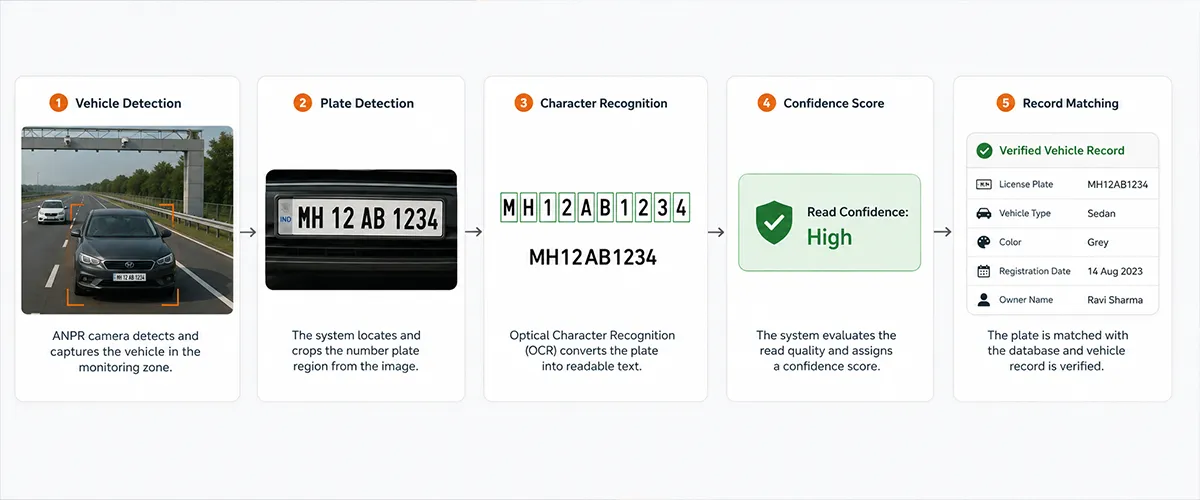
How an Automatic Number Plate Recognition (ANPR) System Turns a Plate Into Data
An ANPR system, also known as a number plate recognition system, runs a vehicle through a quick pipeline that converts a moving object into a verified alphanumeric string, usually within a few hundred milliseconds of the vehicle entering the frame.
- Vehicle detection: the vehicle is identified.
- Number plate detection: the plate region is isolated from the vehicle body.
- Character recognition: skew is corrected, and pixels are converted into text.
- Confidence scoring: every read receives a reliability value.
- Record matching: the string is checked against registration or account records.
That confidence score matters more than people realize; it’s what lets a system treat an uncertain read differently from a certain one, which is what makes automated enforcement defensible.
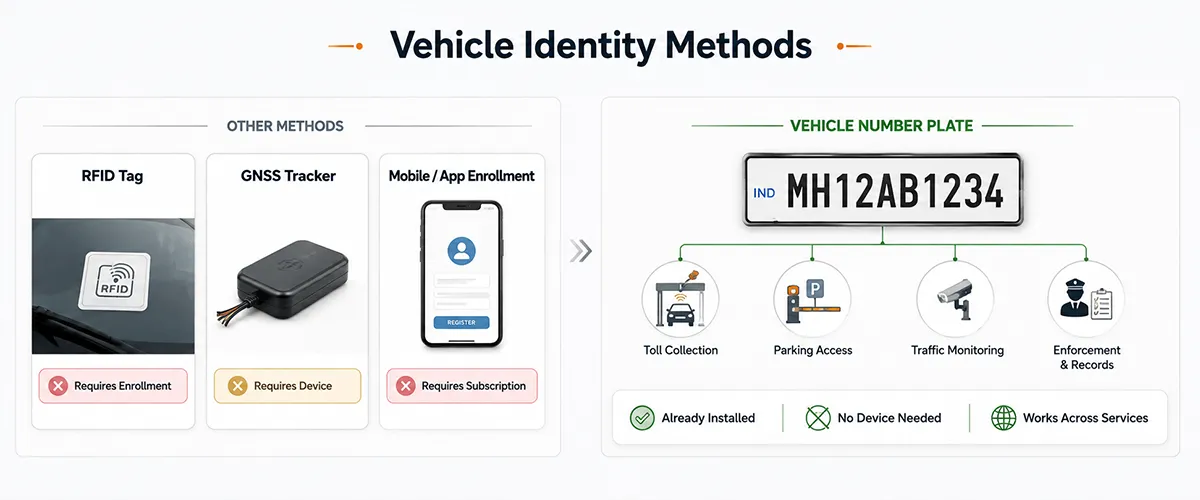
What Makes the Number Plate a Universal Vehicle Identifier
Several technologies can identify a vehicle, RFID tags, GNSS trackers, but they only work for vehicles that are enrolled in them. Unlike those, a vehicle license plate recognition system works on any vehicle already on the road, enrolled or not. The number plate is the one externally visible identifier every legal vehicle already carries, with no device, battery, or subscription required.
- Zero adoption cost, with no tag-issuance program.
- Universal coverage, including out-of-state and unenrolled vehicles.
- Retrospective search of archived footage after an incident.
- Interoperability across toll, parking, and police.
That’s what makes it the natural backbone for tolling, parking, violation detection, and traffic analysis alike: one system, queried by many services, instead of separate infrastructure for each.
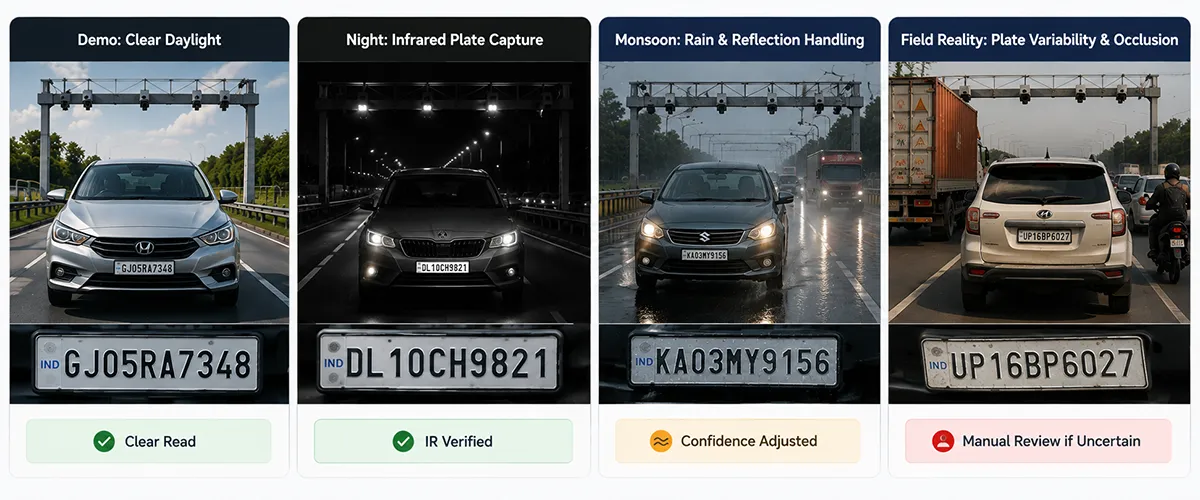
What Separates Production ANPR From a Demo Version
Reading a clean plate in daylight is a solved problem. Holding accuracy through night operations, monsoon conditions, mixed fleets, and non-standard plates is what actually separates a working deployment from a proof of concept or demonstration. Field-critical capabilities include edge inference for low-bandwidth sites, infrared capture for night reads, and support for regional plate formats to get there.
The stakes are also different from ordinary traffic measurement. A miscounted vehicle skews a statistic, but a misread character can send a penalty to the wrong person, so error tolerance in enforcement is tighter than procurement documents usually assume. Mature deployments answer this with confidence thresholds, human review of uncertain reads, and audit trails.
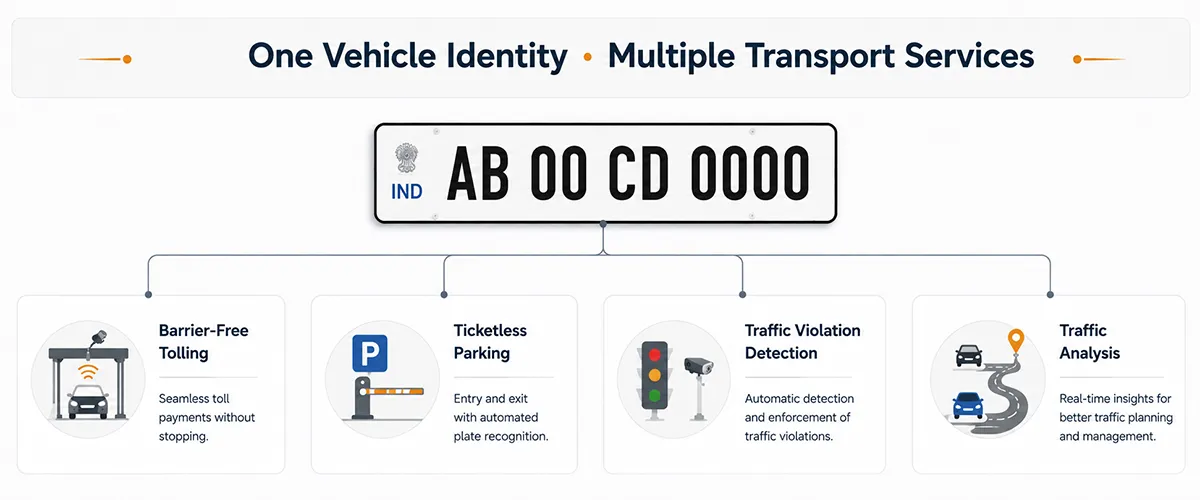
The Number Plate Is Becoming the Login Credential of the Road
Inside an intelligent transportation system, ANPR doesn’t stay confined to one job; it works as a shared service that different modules query independently, which is why it’s increasingly built as common infrastructure rather than bought separately for each use case.
- ANPR for toll and parking management: barrier-free tolling, ticketless parking and duration-based billing, and entry and exit access management.
- ANPR for traffic violation detection: red light jumping, over-speeding, wrong-way driving, and automated challan generation.
- ANPR traffic analysis: origin and destination studies, corridor journey times, vehicle trajectory mapping across camera networks, and classified counts.
That range is possible because the plate is the one identifier every vehicle already carries – no tag, no device, no enrollment required. It’s what lets payment, enforcement, and access decisions all run off the same underlying read. The next phase of intelligent transportation depends on identity, reliable enough to act on automatically, and that’s exactly where Intozi already operates. Intozi has built this into real deployments, where performance in live, unpredictable conditions is what has earned plate identity the trust to be acted on automatically.
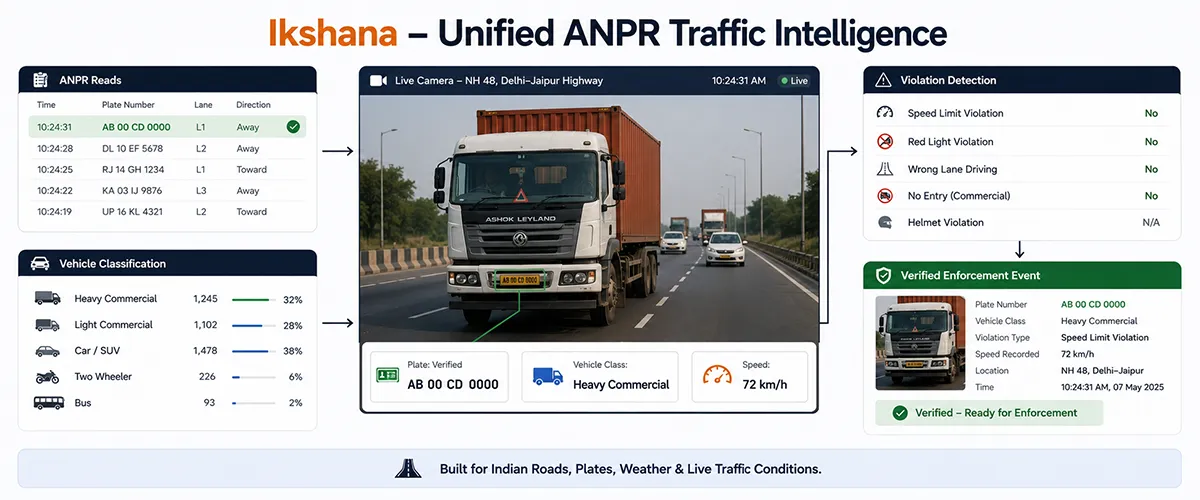
Intozi and the Future of ANPR Traffic Solutions
Vendors aren’t judged on benchmark accuracy. They’re judged on how a system behaves at 2 a.m. in heavy rain on an unlit corridor. That’s the standard Intozi builds to. Its computer vision technology is built for traffic and transportation environments, tuned specifically for Indian road, plate, and weather conditions. Ikshana, Intozi’s AI video analytics platform, applies ANPR alongside vehicle classification and violation detection, so plate identity feeds the same analytics layer rather than an isolated module.
As transport networks automate, ANPR’s real value isn’t in a standalone product – it lies in becoming a shared identity layer that multiple systems can query. That’s exactly where Ikshana already operates, deployed in live, unpredictable conditions, proven under exactly that pressure. Intozi continues to explore new use cases for plate-level identity, pushing reliability further so it can extend across more industries and deployment conditions than it covers today.
Frequently Asked Questions (FAQS)
An ANPR system identifies the vehicle, isolates the plate region, corrects for angle and distortion, and then converts the characters into text using optical character recognition. Infrared illumination and short exposure freeze motion and cut headlight glare, which is why dedicated ANPR systems outperform standard CCTV. The system then scores each read for confidence and checks it against registration or account records before creating an event.
Yes, when the deployment is engineered properly and includes safeguards. Reliable enforcement depends on quality capture hardware, confidence scoring on every read, validation against official registration records, and a review process for low-confidence results. Most jurisdictions also require supporting evidence such as a scene image and timestamp. Lab accuracy claims mean little; sustained performance at night, in rain and across non-standard plates is what counts.
Yes. ANPR identifies vehicles purely from the registration plate, so it works on any vehicle regardless of whether a tag is fitted, active, or funded. That is why it serves as the enforcement layer in tag-based tolling. Most large deployments combine both: the tag handles fast payment for enrolled vehicles, while ANPR catches unenrolled vehicles, tag mismatches, and cloned transponders that would otherwise pass undetected.
ANPR is now used across parking, security, logistics, and city traffic management. Common applications include ticketless parking with duration-based billing, campus access, stolen vehicle alerts, restricted zone enforcement, and vehicle trajectory analysis via journey time measurement between camera pairs. Increasingly, it also runs as a core module inside a broader intelligent traffic management system, feeding vehicle-level identity to whichever service needs it. In each case the value is the same: linking a physical vehicle to a digital record so that access, billing, or enforcement can happen automatically.
ANPR identifies vehicles, not drivers, and well-governed systems limit what is retained. Responsible deployments apply purpose limitation, defined retention periods, access controls, and audit logging, and many analytics use cases run on hashed or aggregated identifiers rather than readable plate data. The privacy risk comes from unrestricted retention and cross-system linkage rather than from recognition itself, which is why data governance is treated as a core design requirement.
Upgrade Your Operations With Next-Generation AI Video Analytics
Intozi Tech Pvt Ltd
Unit no- 629, 644, 645 Tower B2, Spaze I-Tech Park, Sohna Road Sec 49, Gurgaon, Haryana-122018
MON-FRI 09:00 - 20:00, SAT 10:00 - 14:00