
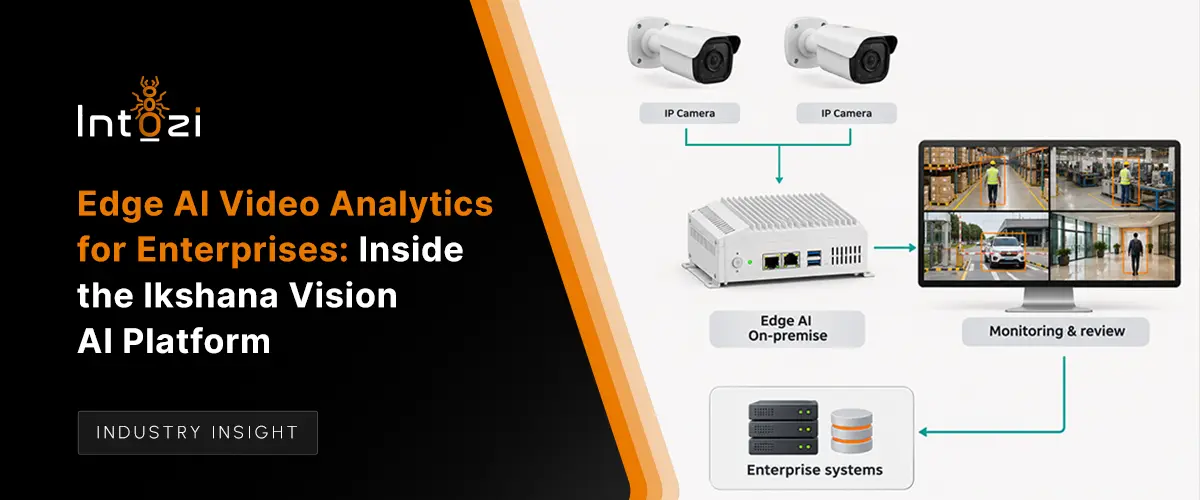
Edge AI Video Analytics for Enterprises: Inside the Ikshana Vision AI Platform
Enterprises generate large volumes of video data through CCTV cameras and connected surveillance systems. However, collecting footage alone does not provide actionable information about security events, workplace activities, or operational risks. An AI video analytics platform can turn compatible video streams into useful insights by identifying predefined events and notifying teams when attention is required. With edge AI processing, organizations can analyze video closer to where it is generated, supporting responsive monitoring while potentially reducing the need to transmit every video stream to a central server.
Why Enterprises Are Moving Towards Edge AI Video Analytics
Traditional video surveillance often depends on continuous human observation or centralized processing. As camera networks expand, managing large volumes of video can increase bandwidth requirements, processing workloads, and monitoring complexity.
Edge AI addresses some of these challenges by processing video near the camera or within local computing infrastructure.
Key advantages include:
- Faster event processing: Analyze supported video feeds closer to their source.
- Reduced bandwidth requirements: Send selected events or relevant footage instead of continuously transmitting every stream, where the architecture allows.
- Local processing: Support deployments where video processing needs to remain within enterprise premises.
- Scalable infrastructure: Extend analytics across multiple locations based on processing capacity and network requirements.
- Responsive alerts: Identify configured events and notify relevant teams.
The actual benefits depend on hardware capacity, network architecture, camera compatibility, and the complexity of analytics models.
How an Enterprise Video Analytics Solution Works
An enterprise video analytics solution combines camera infrastructure, computer vision models, processing hardware, and monitoring interfaces to identify selected events.
A typical workflow involves:
- Video input: Compatible CCTV or IP cameras provide video streams.
- AI processing: Configured computer vision models analyze the incoming footage.
- Event detection: The system identifies predefined activities, objects, or conditions.
- Alert generation: Detected events trigger notifications based on configured rules.
- Human verification: Operators review alerts and decide whether further action is necessary.
This approach can help organizations move beyond passive recording towards event-based video monitoring.
What Makes an Intelligent Video Analytics Platform Useful
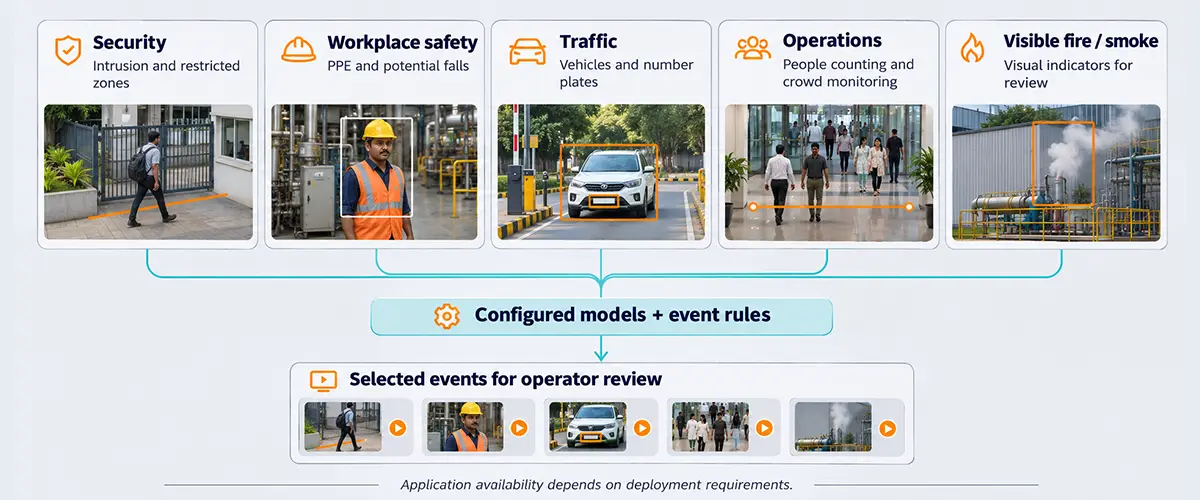
An intelligent video analytics platform should support more than basic motion detection. Enterprises need configurable analytics that can address different operational requirements across departments and locations.
Depending on the deployment, useful capabilities may include:
- Security analytics: Intrusion detection, perimeter monitoring, and restricted-area access alerts.
- Workplace safety: PPE detection, fall detection, and selected unsafe activity monitoring.
- Traffic analytics: Vehicle detection, classification, and number plate recognition were configured.
- Operational monitoring: People counting, crowd monitoring, and activity analysis.
- Fire and smoke detection: Identification of visible fire or smoke indicators through suitable detection models.
The required capabilities vary by industry, camera environment, and business objectives. Not every analytics function is automatically available in every deployment.
The Role of No-Code Configuration in Computer Vision
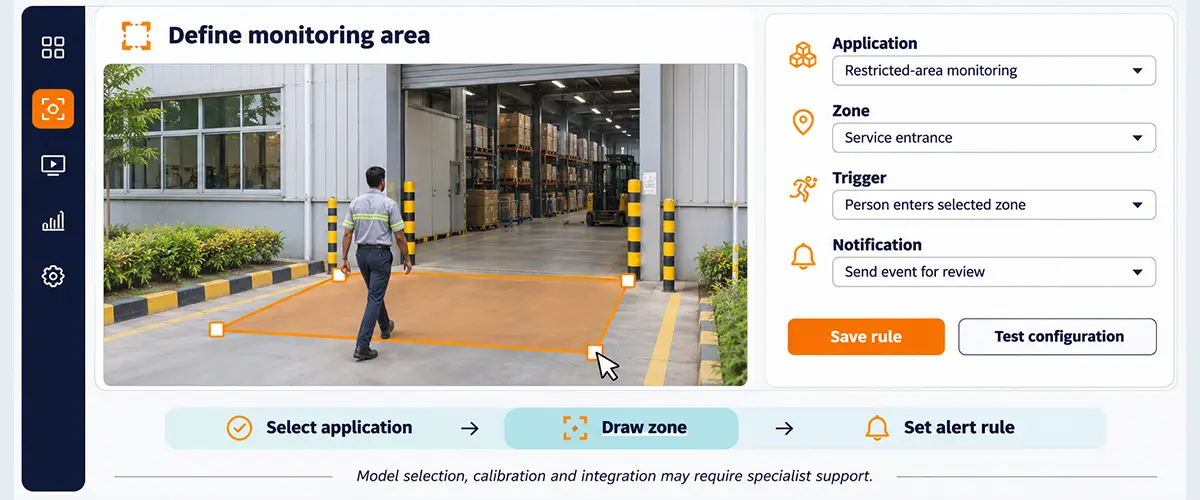
Traditional computer vision deployments may require specialized development resources to configure models, define detection areas, and manage analytics workflows. A no-code computer vision platform can simplify selected configuration tasks through visual interfaces and predefined settings.
For enterprise teams, this can support:
- Defining virtual boundaries and restricted zones.
- Configuring event-based detection rules.
- Selecting monitoring areas within camera views.
- Managing analytics settings without extensive coding.
- Adjusting alert conditions based on operational requirements.
No-code configuration does not eliminate the need for technical expertise. Model selection, camera calibration, system integration, and complex customizations may still require specialist involvement.
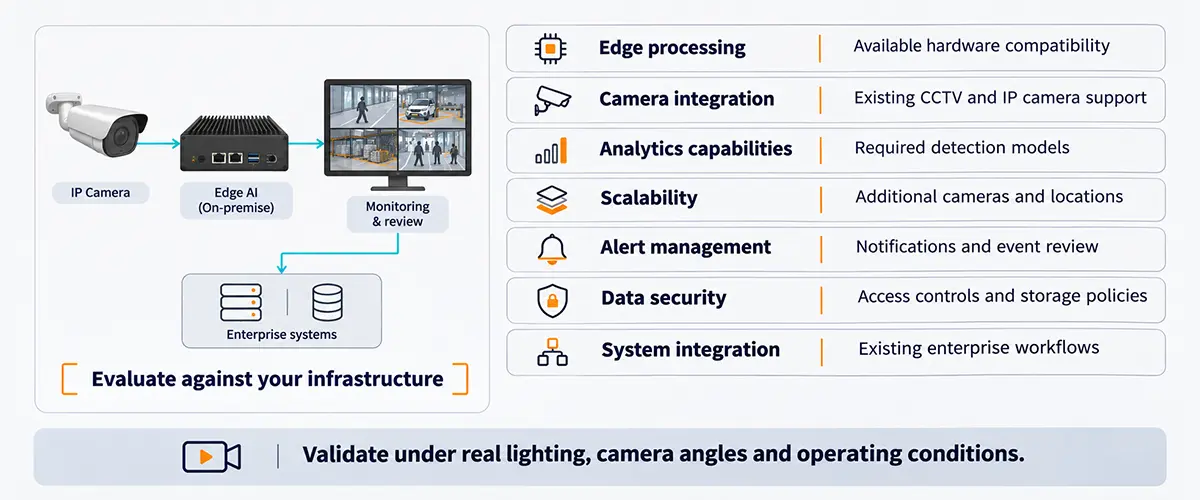
Selecting the best video analytics software depends on the organization’s infrastructure, security requirements, and intended applications. A solution that works well in one environment may not be suitable for another.
Consider the following factors:
Evaluation Area | What to Check |
Edge processing | Compatibility with available edge hardware |
Camera integration | Support for existing CCTV and IP camera systems |
Analytics capabilities | Availability of required detection models |
Scalability | Ability to support additional cameras and locations |
Alert management | Configurable notifications and event review |
Data security | Access controls, storage policies, and deployment architecture |
Integration | Compatibility with existing enterprise systems |
A practical evaluation should include real-world testing under the facility’s lighting, camera angles, and operating conditions.
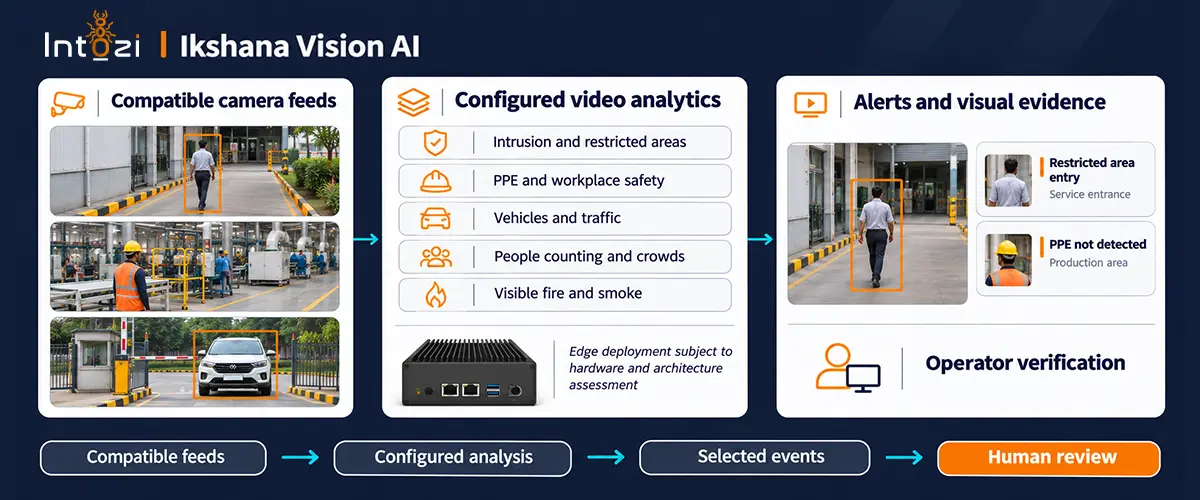
Intozi’s Ikshana Vision AI Platform is designed to support video analytics applications across enterprise and industrial environments. It uses AI-powered video analysis to help organizations identify configured events across compatible camera feeds.
Depending on deployment requirements, Ikshana can support applications such as:
- Intrusion and restricted-area detection.
- PPE and workplace safety monitoring.
- Vehicle and traffic analytics.
- People counting and crowd monitoring.
- Visible fire and smoke detection.
As a video analytics solution, Ikshana can help enterprises convert selected video events into alerts and actionable visual information. Its suitability for edge deployments depends on the supported hardware, processing architecture, camera infrastructure, and integration requirements.
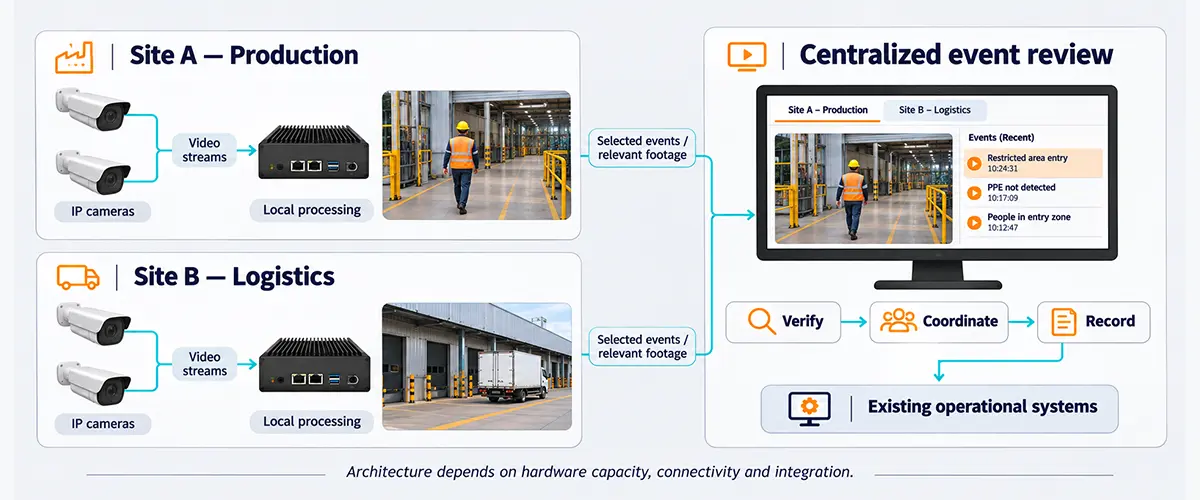
Building a More Responsive Enterprise Monitoring Environment
An effective video analytics solution should fit into existing enterprise workflows rather than operate as an isolated surveillance tool. Edge AI can support local video processing, while centralized interfaces can help teams review events across different locations.
By combining suitable cameras, configured computer vision models, and appropriate processing infrastructure, enterprises can develop monitoring systems that are more responsive to security, safety, and operational requirements. Intozi‘s Ikshana can bring these capabilities together through its Vision AI approach, helping organizations apply AI video analytics to existing IP/CCTV infrastructure in suitable environments.
Frequently Asked Questions (FAQs)
An edge AI video analytics platform processes video near its source instead of depending entirely on remote cloud infrastructure. This can support faster event identification and reduce continuous video transmission, depending on the architecture. Intozi’s Ikshana supports Vision AI applications, with edge deployment suitability depending on the selected hardware and configuration.
An enterprise video analytics solution can identify configured events such as intrusion, restricted-area entry, and unusual movement. It can generate alerts that help security personnel review relevant camera feeds. Intozi’s Ikshana supports configurable security analytics applications for suitable enterprise environments.
A no-code computer vision platform can simplify tasks such as defining detection zones, setting event rules, and configuring selected analytics through visual interfaces. However, advanced integrations and specialized model development may still require technical expertise. Intozi’s Ikshana provides Vision AI capabilities that can be configured according to deployment requirements.
Enterprises should evaluate camera compatibility, edge processing capabilities, detection accuracy, alert management, scalability, data security, and integration options. The required features should match specific operational objectives. Intozi’s Ikshana supports multiple video analytics applications that organizations can assess against their infrastructure and monitoring needs.
Yes, edge AI can support large enterprise deployments across multiple facilities when processing capacity, network architecture, and system integration are planned appropriately. Organizations should evaluate hardware requirements and centralized management capabilities before deployment. Intozi’s Ikshana can support enterprise video intelligence applications based on the selected deployment architecture.
Upgrade Your Operations With Next-Generation AI Video Analytics
Intozi Tech Pvt Ltd
Unit no- 629, 644, 645 Tower B2, Spaze I-Tech Park, Sohna Road Sec 49, Gurgaon, Haryana-122018
MON-FRI 09:00 - 20:00, SAT 10:00 - 14:00