
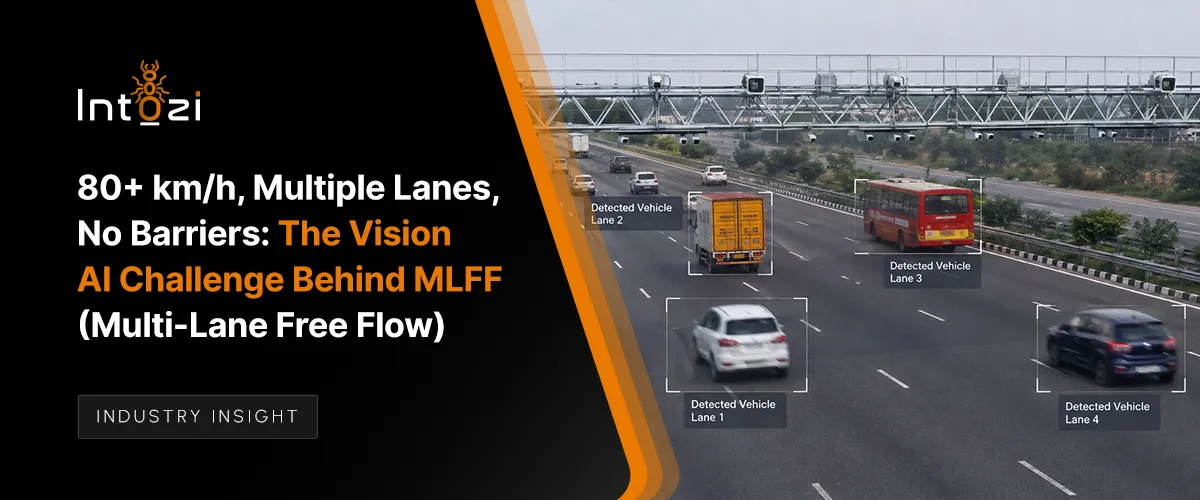
80+ km/h, Multiple Lanes, No Barriers: The Vision AI Challenge Behind MLFF (Multi-Lane Free Flow)
A vehicle travelling at 80 km/h covers nearly 22 meters every second. Within a fraction of that second, a highway operator must detect the vehicle, classify it, read its number plate, associate it with a payment identity, and decide whether a violation occurred, all with no barrier to slow anything down. This is the operating reality behind Multi-Lane Free Flow (MLFF) tolling, and it’s why reliable Vision AI has become the foundation of barrier-free highway infrastructure rather than an add-on to it.
Traditional toll plazas worked differently. Lanes were narrow, speeds were low, and a boom barrier guaranteed a second chance if the technology failed. MLFF removes all three safeguards at once. What remains is perception, and whatever the cameras and algorithms miss becomes lost revenue, an unenforced violation, or a disputed transaction.
Why Barrier-Free Tolling Has Raised the Stakes for Highway Operators
Toll plazas are among the most persistent bottlenecks in highway networks, generating queues, idling emissions, fuel waste, and rear-end collision risk. Free-flow tolling eliminates the stop entirely, but it also transfers responsibility for accuracy from mechanical control to software, making detection quality a direct commercial concern. That shift changes the economics of traffic management for highways in three ways:
- Every unread vehicle is a permanent revenue leakage, repeated thousands of times a day.
- Enforcement becomes evidentiary rather than physical, so image quality determines whether a penalty is defensible.
- Errors scale invisibly; even a small read-failure rate on a busy corridor compounds quickly across a full day’s traffic
Accuracy, in other words, is no longer a technical metric. It is the business model.
How Vision AI Powers Detection at Full Highway Speed
The perception pipeline under an MLFF gantry runs in milliseconds and follows a strict sequence, because every downstream decision depends on correctly isolating one vehicle from a moving, overlapping stream of traffic crossing several lanes simultaneously. A production pipeline typically performs the following steps:
- Detection and tracking: Each vehicle is identified and assigned a persistent track as it approaches the gantry.
- Classification: The system determines vehicle class (cars, LCVs, buses, multi-axle trucks) to apply the correct toll category.
- Plate recognition: ANPR reads the registration plate using dedicated high-shutter cameras and infrared illumination.
- Identity fusion: the visual read is matched against RFID or FASTag data to confirm a valid payment identity.
- Evidence packaging: Plate crop, contextual overview image, timestamp, lane, gantry ID, and speed are bundled into an auditable record.
Only when these stages agree can the transaction be trusted. When they disagree, the system must flag the discrepancy rather than guessing.
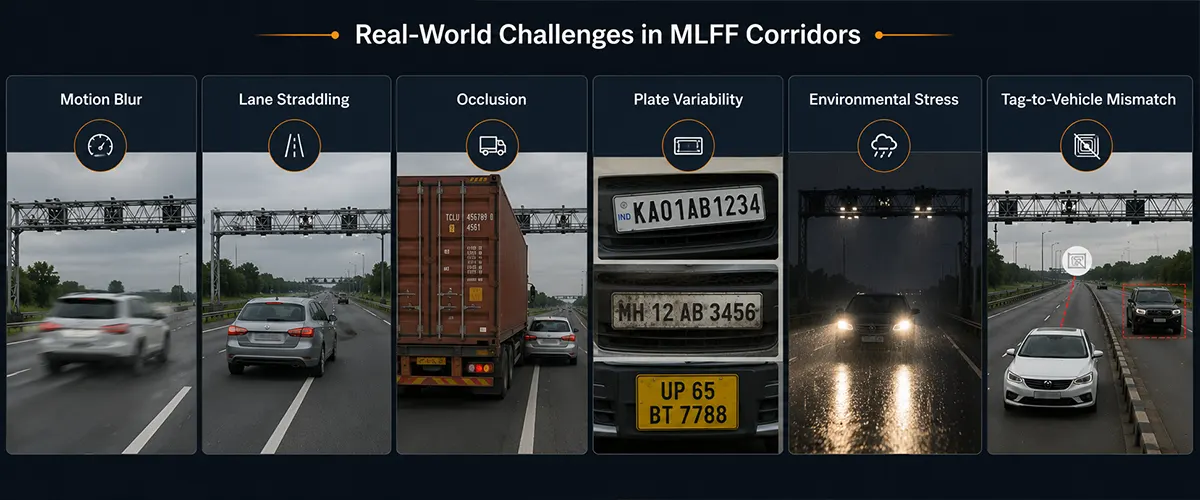
The Hardest Perception Problems Under an MLFF Gantry
Most MLFF failures are not algorithmic failures in the abstract; they are physics and environment problems that only appear at speed, at night, or in dense mixed traffic. Engineering teams design around a predictable set of conditions that repeatedly break naive computer vision deployments.
- Motion blur – Highway speed demands very short exposure times and powerful synchronized IR illumination
- Lane straddling – Without barriers, drivers change lanes directly beneath the gantry, breaking any assumption that one lane equals one vehicle.
- Occlusion – A heavy commercial vehicle can fully hide a car in an adjacent lane from a single camera angle.
- Plate variability – Non-standard fonts, damaged, dirty, tilted or bumper-mounted plates remain common across India’s mixed vehicle fleet.
- Environmental stress – Headlight bloom, low sun angle, fog, dust and monsoon rain each degrade image quality differently.
- Tag-to-vehicle mismatch – Associating the correct FASTag/RFID read with the correct visual identity is essential to detect cloned or misused tags.
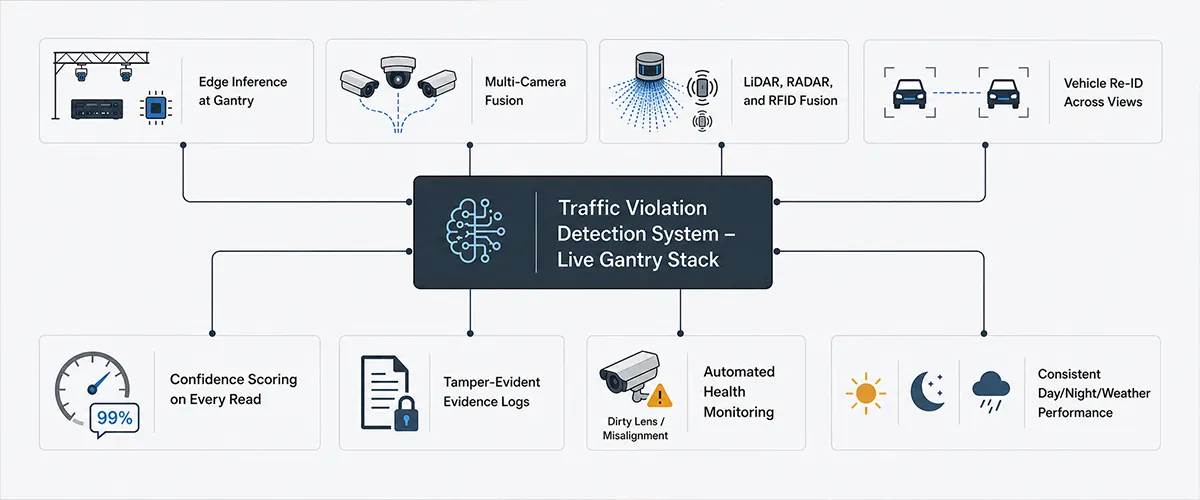
What a Production-Grade System Needs to Get Right
Field reliability depends less on model accuracy in a lab and more on system architecture, built to degrade gracefully, prove its own decisions, and keep operating when connectivity or lighting conditions are imperfect:
- Edge inference at the gantry, so performance doesn’t depend on bandwidth
- Multi-camera fusion for redundancy against occlusion
- Vehicle re-identification across camera views
- Confidence scoring on every read
- Tamper-evident evidence logs for defensible enforcement
- Automated health monitoring that flags a dirty lens or misaligned camera before revenue is affected
- Consistent performance across day, night, and adverse weather, not just clean daylight conditions
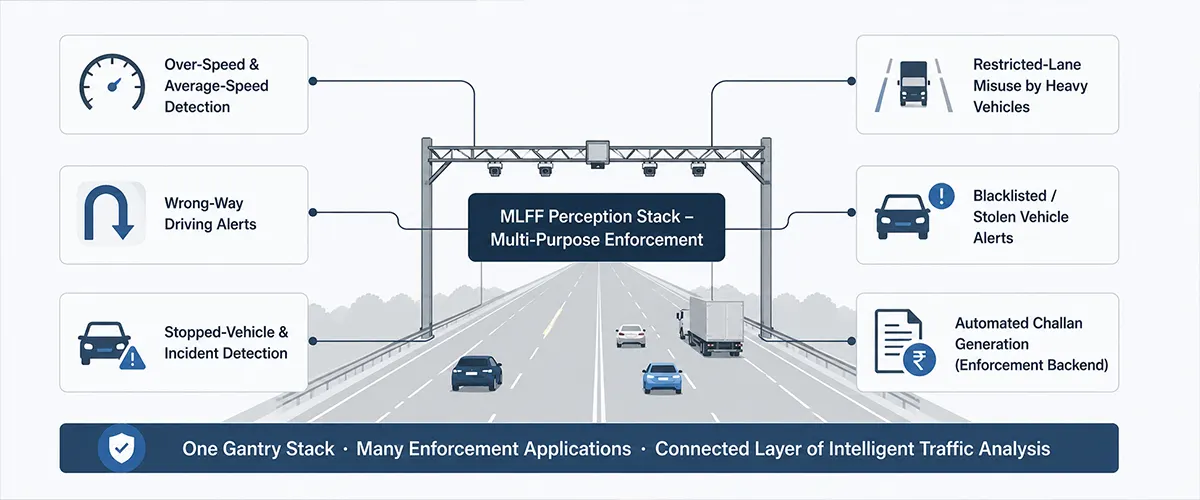
Applications That Extend Beyond Toll Collection
The same gantry-mounted perception stack that powers a tolling doesn’t stop there. It can act as a traffic violation detection system. Once vehicles can be reliably identified in free-flow conditions, that stack becomes the backbone of a much broader traffic enforcement system. This is why most modern deployments are specified as multi-purpose AI traffic management system infrastructure from the outset, rather than single-function tolling hardware. It’s also where traffic management for highways starts to look less like isolated tools and more like one connected layer of intelligent traffic analysis solutions across a corridor.
Common extensions include:
- Over-speed and average-speed detection
- Wrong-way driving alerts
- Stopped-vehicle and incident detection
- Restricted-lane misuse by heavy vehicles
- Blacklisted or stolen vehicle alerts
- Automated challan generation, integrated with enforcement backends
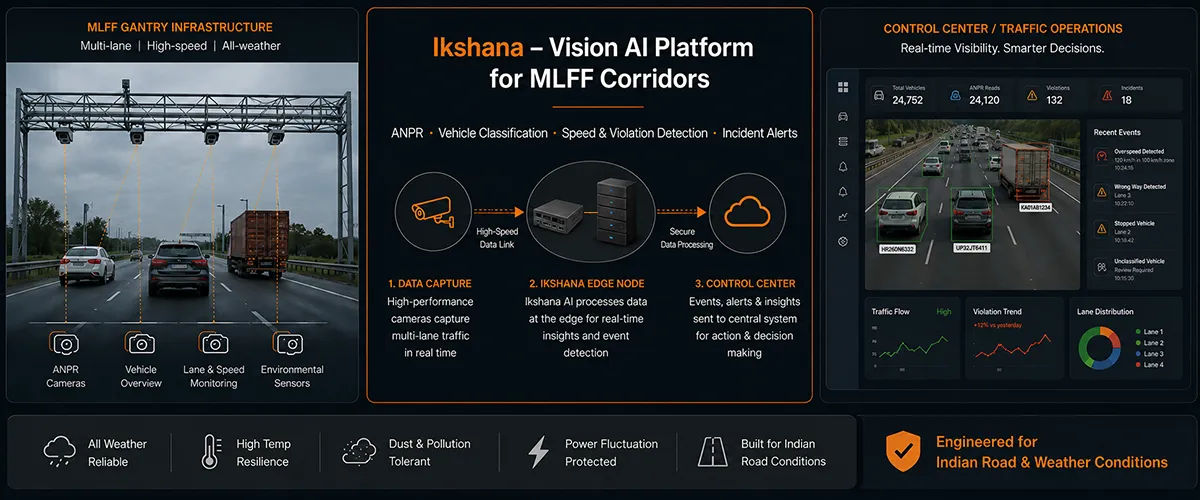
Where Intozi Fits: Two Live MLFF Deployments on NH-48
This isn’t a theoretical framework for Intozi. Ikshana, our Vision AI platform, currently powers 2 of India’s 6 live MLFF tolling systems: Manoharpura Toll Plaza, our first MLFF deployment, and Shahjahanpur Toll Plaza, both on the Delhi–Jaipur stretch of NH-48.
At both sites, Ikshana delivers high-accuracy real-time ANPR and vehicle classification data directly to NHAI’s central tolling systems, at full highway speed, across day, night, and adverse weather. Beyond tolling, the same gantry-mounted perception stack can extend naturally into over-speed detection, wrong-way driving alerts, and incident detection, the capabilities already built into Ikshana’s broader traffic and safety offering.
As more of India’s highway network moves toward MLFF barrier-free operation, accuracy at speed becomes the single determinant of success – financially and legally. Intozi has already proven this model works on NH-48 and intends to bring that same standard to the rest of India’s highways.
Frequently Asked Questions (FAQs)
MLFF tolling uses overhead gantries fitted with cameras and sensors instead of physical lanes. As a vehicle passes at normal highway speed, the system detects it, classifies its type, reads the number plate using ANPR, and matches it with a Fastag/RFID. The toll is then charged automatically to the linked account. Because there is no barrier, every step happens in milliseconds and depends entirely on accurate detection rather than mechanical enforcement.
Yes, provided the hardware is specified correctly for high-speed capture. Accurate reads at 80 km/h require global-shutter cameras, very short exposure times, synchronized infrared illumination, and precise trigger timing to freeze motion. Software then handles skew, glare, and partial occlusion. Well-configured systems routinely achieve high read rates, but performance drops sharply with consumer-grade cameras, poor mounting angles, or inadequate lighting, which is why site engineering matters as much as the recognition model itself.
Most misses come from physical conditions rather than software limitations. Common causes include a truck occluding a smaller vehicle in an adjacent lane, a vehicle changing lanes directly under the gantry, plates that are damaged, obscured, non-standard or covered in road grime, and severe weather such as fog or heavy rain. Headlight glare at night is another frequent factor. Multi-camera redundancy and confidence scoring reduce these gaps but rarely eliminate them completely.
An MLFF installation typically combines ANPR, vehicle detection and classification algorithms, Fastag/RFID readers, laser or lidar profiling for axle counting, edge computing hardware at the gantry, and a central transaction and enforcement backend. No single technology is sufficient on its own; accuracy comes from fusing several independent inputs and flagging cases where they disagree.
The system captures the vehicle visually and creates a violation record instead of a standard transaction. This record usually contains the plate image, a contextual overview image, timestamp, lane, gantry identifier, and speed. The registration is then checked against the vehicle database, and a notice or automated challan is issued to the registered owner. Because there is no barrier to stop the vehicle, the quality of the captured evidence determines whether the penalty is enforceable.
Upgrade Your Operations With Next-Generation AI Video Analytics
Intozi Tech Pvt Ltd
Unit no- 629, 644, 645 Tower B2, Spaze I-Tech Park, Sohna Road Sec 49, Gurgaon, Haryana-122018
MON-FRI 09:00 - 20:00, SAT 10:00 - 14:00