
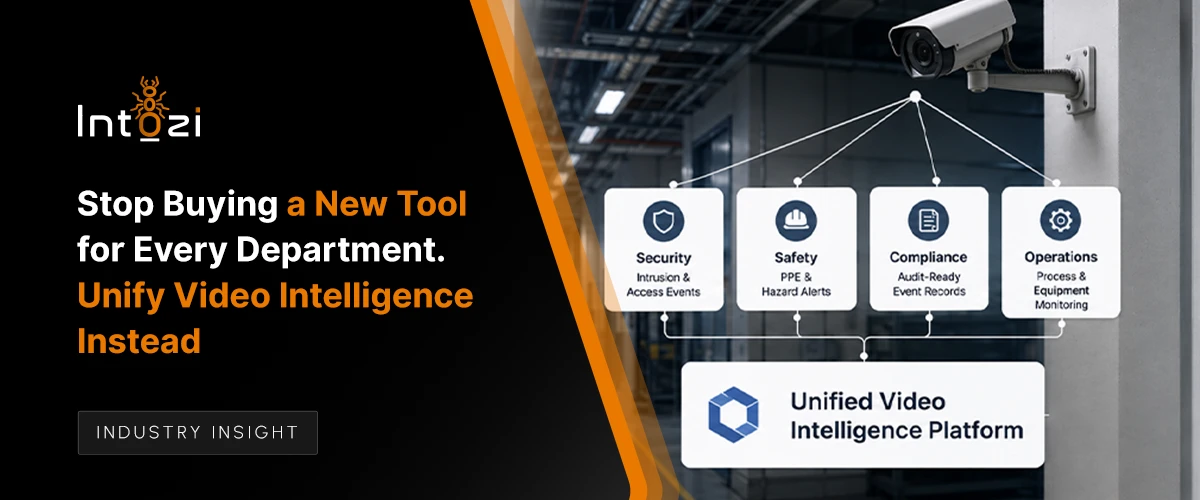
Stop Buying a New Tool for Every Department. Unify Video Intelligence Instead
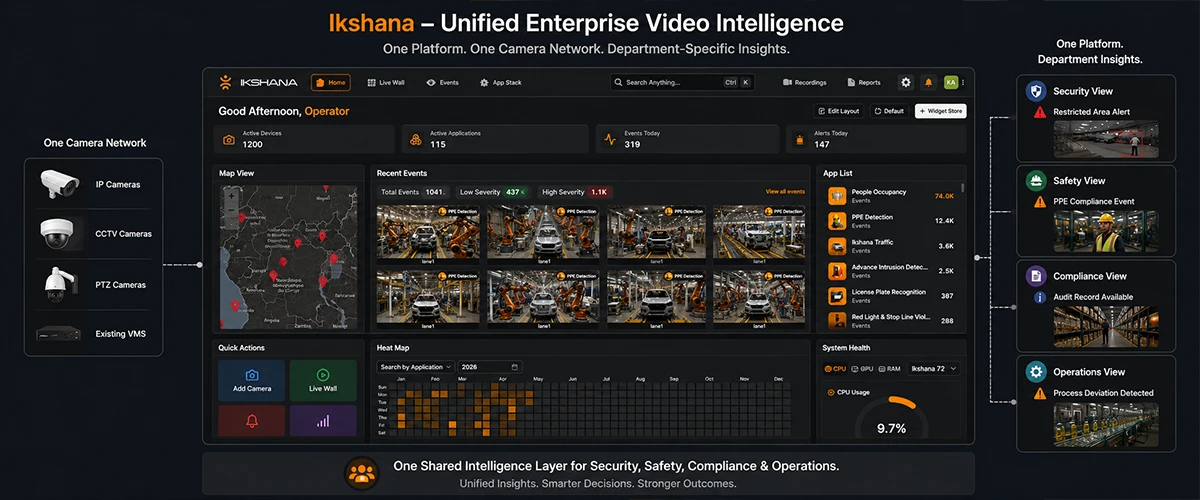
Every department sees the same cameras differently. Security wants intrusion alerts. Safety wants PPE compliance. Operations wants process monitoring. Compliance wants audit trails. So each team buys its own tool, and the organization ends up running a dozen disconnected systems on the same camera network, each with its own dashboard, vendor, and login.
A unified AI video analytics platform solves this by running multiple computer vision models on your existing cameras at once, giving every department the intelligence it needs from one shared system instead of one tool each.
Why Every Department Ends Up With Its Own Tool
Nobody sets out to run a dozen video analytics systems. It happens gradually: the security team buys an intrusion-detection tool, safety adds a PPE-compliance system, operations brings in a separate process-monitoring platform, and compliance layers on an audit tool of its own. Each purchase solves one team’s problem in isolation.
Over time, this creates a stack of overlapping problems:
- Multiple dashboards and logins for the same cameras
- Different vendors, contracts, and renewal cycles
- Separate alerting systems that don’t talk to each other
- Duplicated infrastructure costs across departments
- No shared visibility across sites or teams
- Friction and a new procurement cycle every time a department needs a new capability
A unified platform removes this by giving every department a common foundation instead of a separate stack.
One Platform, Every Department’s Use Case
A single video analytics platform can run multiple AI models on the same camera feeds simultaneously, which means the same infrastructure that serves security can serve safety, compliance, and operations at the same time, without a separate deployment for each.
For the Security Team
Traditional CCTV relies on operators watching walls of screens, a model that breaks down as camera counts rise. AI video analytics monitors every feed continuously and surfaces only what needs attention: intrusion detection, restricted-area movement, and unauthorized access. It doesn’t replace human judgment; it focuses operators on what matters so they respond faster.
For the Safety Team
The same cameras that secure a facility can also protect the people working in it, flagging PPE non-compliance, unsafe activity, and safety-zone violations in real time, instead of relying on periodic manual walkthroughs.
For the Compliance and Operations Teams
Industrial and enterprise sites generate enormous volumes of footage, and recording alone delivers no real-time value for compliance or operations. Real-time video analytics software converts camera activity into structured events these teams actually need: process adherence monitoring, equipment and machine-state monitoring, hazard detection, and access control across production floors, warehouses, and critical infrastructure.
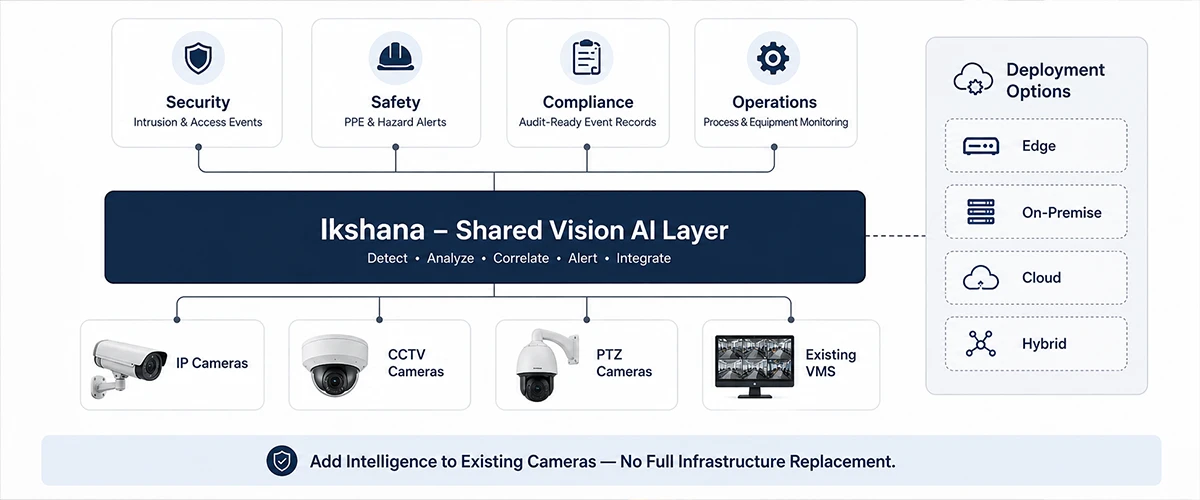
How Ikshana Delivers This on the Cameras You Already Have
Ikshana from Intozi brings security, safety, compliance, and operational analytics into one vision AI platform instead of treating each department as a separate project: centralized video intelligence, real-time event detection, multiple concurrent AI use cases, multi-site analysis, and integration with each department’s existing workflows. As an intelligent video analytics platform, it gives every team the intelligence it needs from a shared foundation.
This works because Ikshana is built to run on existing IP/CCTV infrastructure when cameras and video management systems expose compatible streams or interfaces. Replacing an entire camera network is expensive, so compatibility is the practical starting point for most enterprises evaluating video analytics software in India and elsewhere. For teams comparing a video analytics solution in India, a real-time AI video monitoring platform that reuses existing cameras is often the most cost-effective route. Before deployment, the key factors to evaluate are camera and stream compatibility, network capacity, processing requirements, existing VMS integrations, and edge vs. centralized processing needs.
Ikshana already runs this way across 25+ smart cities, 50+ defense sites, 10+ airports, and 5+ oil & gas majors, deployed on the video infrastructure those sites already had in place and serving multiple departments from the same deployment.
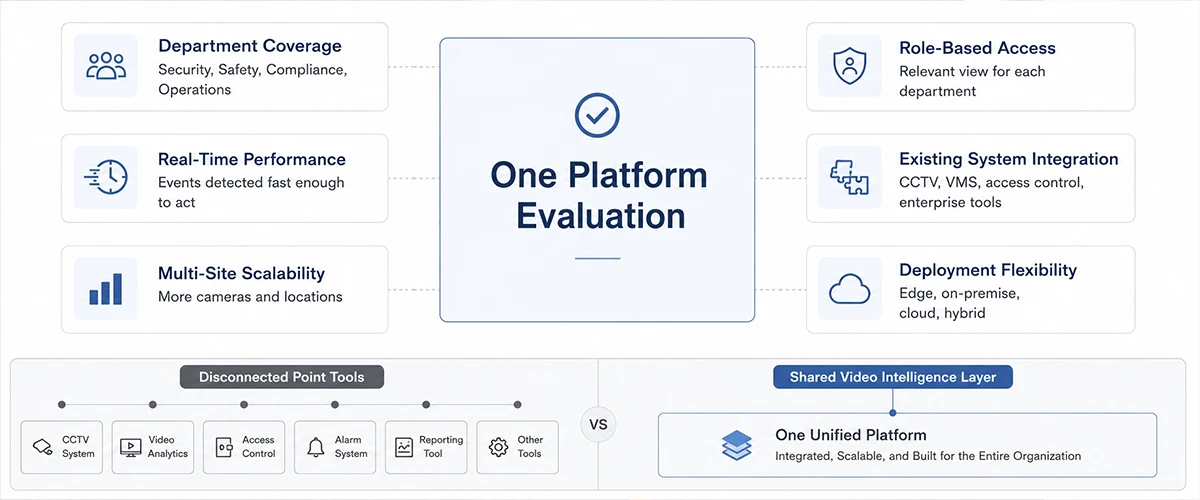
What to Look for When Consolidating Departments Onto One Platform
If you’re evaluating the best video analytics software to replace several departments’ separate tools, scalability has to work in two directions: more cameras and more departments, without a new disconnected stack every time a team needs a new capability. Weigh a platform against:
- Department coverage: does one platform genuinely serve security, safety, compliance, and operations, or only one of them well?
- Real-time performance: does it flag important events fast enough for each team’s needs?
- Scalability: multi-site management, distributed processing, room to add departments later?
- Integration: role-based access so each department sees only what’s relevant to it, plus existing VMS and enterprise systems?
- Deployment flexibility: edge, cloud, or on-prem?
- Centralized management: can an admin team manage access for every department from one place?
An enterprise video analytics solution that covers these delivers more long-term value than a set of disconnected single-purpose tools.
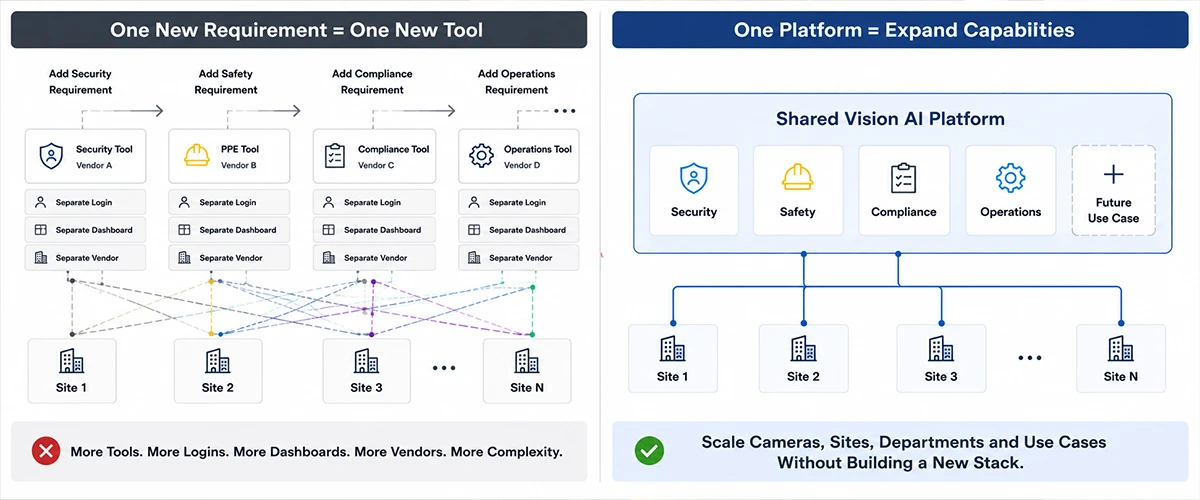
Why This Is the More Scalable Path
Organizations increasingly need video to inform every department’s decisions, not just record incidents for one team to review after the fact. For enterprises evaluating video analytics technologies, the more scalable path is expanding one platform that already covers the departments you have and can onboard the next one without a new procurement cycle, instead of adding a new application every time a department raises a requirement.
Simplify Video Intelligence Across Every Department With Ikshana
A single platform won’t replace every specialized system everywhere, but it removes the need for a separate tool per department and cuts the fragmentation that comes with it. The real opportunity is one shared intelligence layer that every department draws from, security, safety, compliance, and operations alike, built on the cameras you already have.
With Ikshana from Intozi, Security, Safety, Compliance, and Operations teams can all work from the same video analytics solution instead of managing their own separate tools. Talk to the Intozi team to see how Ikshana fits your departments and your infrastructure.
Frequently Asked Questions
Yes. A capable platform runs multiple computer vision models in the same environment, so security, safety, compliance, and operations can each get what they need from the same cameras, without a separate system per department.
Software analyzes video for one team’s specific events. A platform provides a broader environment for managing cameras, analytics, alerts, and users across multiple departments and locations at once.
Usually yes, when cameras and VMS provide compatible streams. Evaluate camera compatibility, network capacity, processing needs, storage, and integrations first to choose the right architecture.
Prioritize department coverage, real-time processing, role-based access so each team sees only what’s relevant to it, scalability, camera compatibility, and flexible deployment.
Separate tools per department create duplicated costs, disconnected alerting, and no shared visibility. A unified platform centralizes intelligence across departments and makes adding a new one easy instead of starting a new procurement cycle.
Ikshana from Intozi analyzes video across security, safety, compliance, and operational functions, giving each department the intelligence it needs from one shared technology foundation instead of separate systems.
Upgrade Your Operations With Next-Generation AI Video Analytics
Intozi Tech Pvt Ltd
Unit no- 629, 644, 645 Tower B2, Spaze I-Tech Park, Sohna Road Sec 49, Gurgaon, Haryana-122018
MON-FRI 09:00 - 20:00, SAT 10:00 - 14:00