
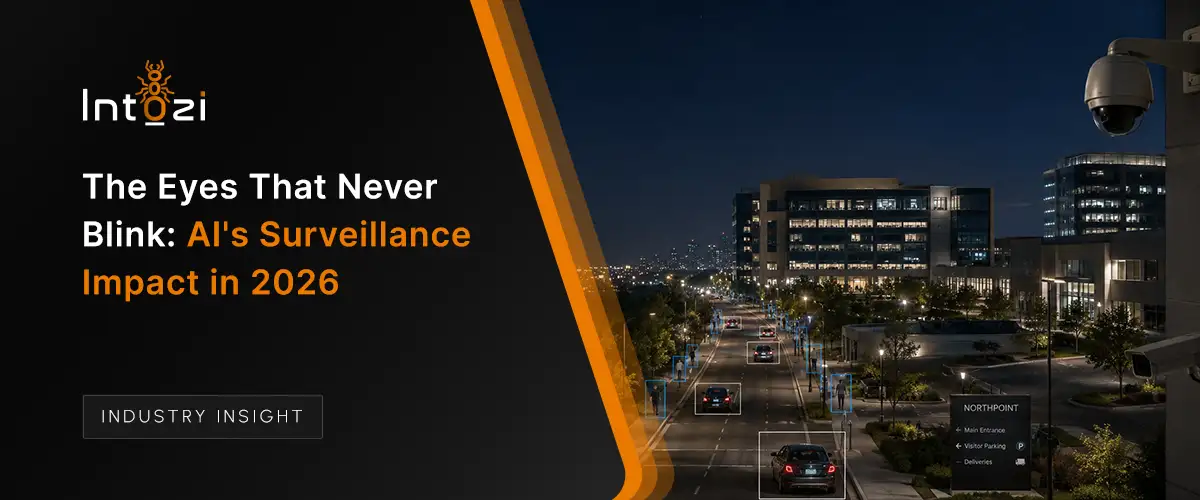
The Eyes That Never Blink: AI's Surveillance Impact in 2026
The world has changed. Cameras no longer simply record; they think. In 2026, AI-powered surveillance has moved from science fiction into the backbone of public safety, enterprise security, and smart city infrastructure. The sheer volume of visual data generated every second demands more than human monitoring. It demands intelligence. And that’s exactly what modern video analytics software delivers, turning passive footage into active, decision-making insight that never sleeps, never blinks, and never misses a detail.
How AI Has Redefined What Surveillance Means
For decades, surveillance meant storage. Terabytes of footage sat on servers, reviewed only after an incident occurred. Today, that model is obsolete. AI has shifted surveillance from reactive to predictive, from recording to understanding. Modern systems don’t just capture images; they interpret behavior, identify anomalies, count crowds, detect abandoned objects, and flag threats in real time, all without a human needing to watch a single screen.
This transformation is powered by deep learning, computer vision, and edge computing, three pillars that have matured dramatically over the past five years. The result is a surveillance ecosystem that is faster, smarter, and more scalable than anything previously imaginable.
The Architecture Behind Always-On Intelligence
At the core of any modern surveillance deployment lies a video analytics platform, a centralized system that ingests video streams from dozens, hundreds, or even thousands of cameras simultaneously. These platforms process visual data through AI models trained to recognize patterns: unusual motion, unauthorized access, license plates, facial structures, and crowd density.
What separates leading platforms from basic systems is their ability to:
- Process streams in real time without latency that compromises response time
- Integrate with existing infrastructure including access controls, alarms, and communication systems
- Scale elastically across single-site deployments and multi-city networks
- Generate actionable alerts rather than raw data dumps that overwhelm security teams
- Learn continuously from new data to improve detection accuracy over time
These capabilities define the modern surveillance architecture, and they are only possible through advanced AI.
Intozi's Role in the Surveillance Revolution
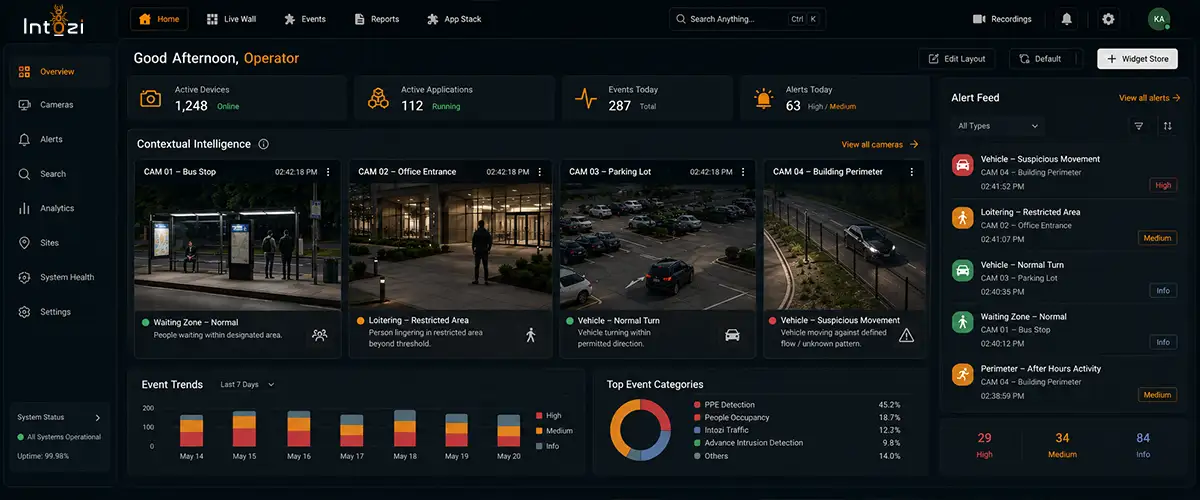
Intozi has emerged as a defining force in intelligent security infrastructure. As a purpose-built video analytics solution, Intozi combines powerful computer vision algorithms with an intuitive management interface designed not just for enterprise IT teams but for operators on the ground who need clarity, speed, and reliability.
What makes Intozi’s approach distinctive is its commitment to contextual intelligence. Rather than generating thousands of low-quality alerts that fatigue security teams, Intozi’s platform is trained to understand context, differentiating between a person waiting at a bus stop and one loitering outside a restricted zone, or between a vehicle making a three-point turn and one conducting surveillance behavior. This distinction between signal and noise is where most legacy systems fail and where Intozi excels.
AI Video Analytics: Beyond Security
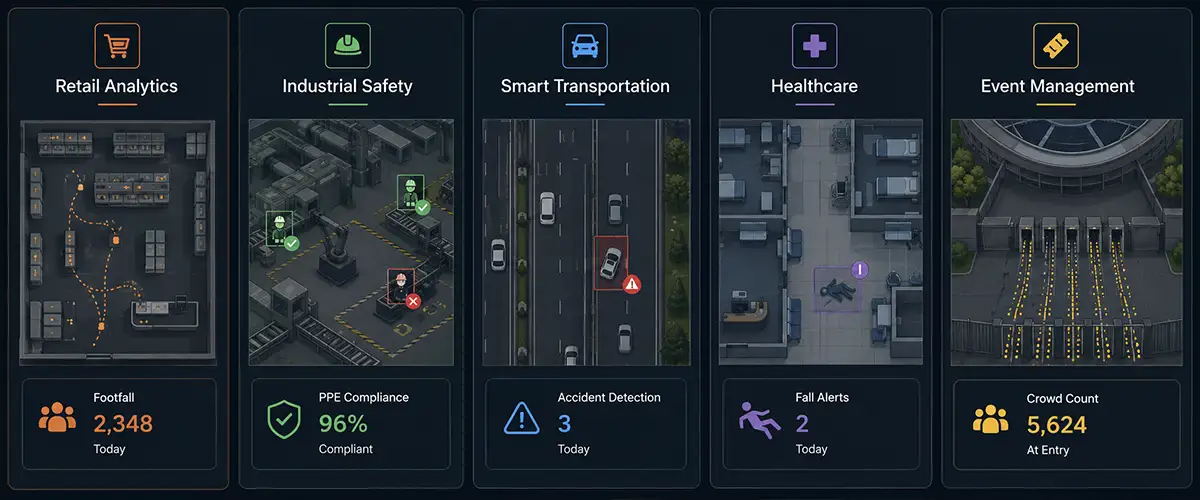
The applications of AI video analytics extend far beyond traditional security use cases. In 2026, organizations are deploying these systems across a remarkably diverse range of functions:
- Retail analytics: tracking foot traffic, dwell time, and conversion behavior in physical stores
- Industrial safety: detecting PPE compliance, unsafe proximity to machinery, and slip/fall risks
- Smart transportation: managing traffic flow, detecting accidents, and optimizing signal timing
- Healthcare: monitoring patient movement in care facilities and flagging falls or distress
- Event management: crowd counting, flow analysis, and emergency evacuation guidance
Each of these use cases is powered by the same underlying technology, adapted to domain-specific needs. The versatility of AI-driven video intelligence has made it one of the most cross-functional technologies of the decade.
Deploying at Scale with an AI-First Platform
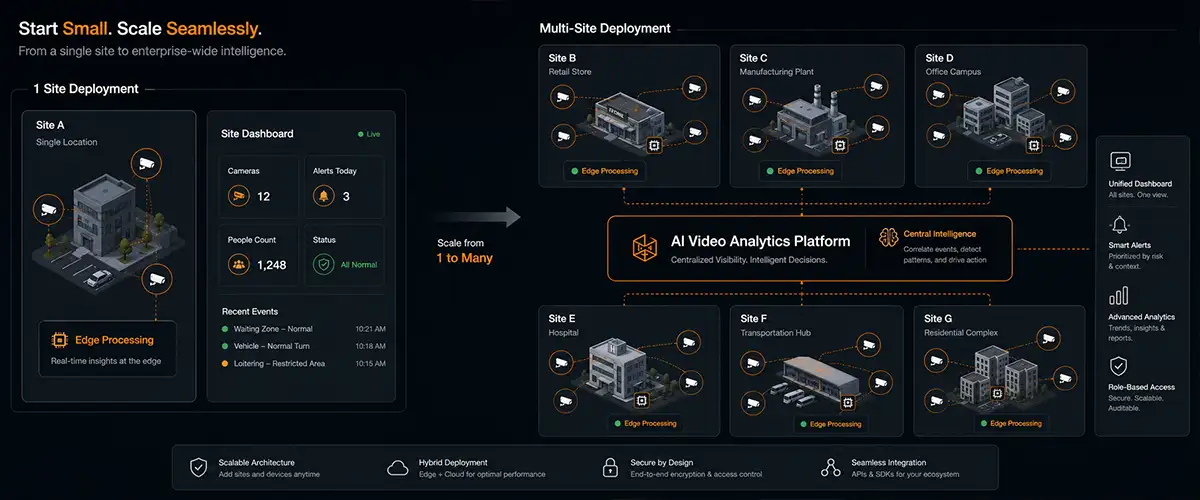
Scaling surveillance intelligently is a challenge that trips up many organizations. Adding cameras without adding intelligence simply creates more noise. The key is deploying an AI video analytics platform that grows with operational demands, one that maintains performance consistency whether managing 10 cameras or 10,000.
Intozi’s infrastructure is architected for exactly this kind of scale. Its distributed processing model allows edge devices to handle local analysis while sending summarized intelligence to central management consoles, reducing bandwidth, improving response times, and enabling deployment in locations with limited connectivity. This hybrid edge-cloud architecture is increasingly the standard for enterprise deployments in 2026.
Privacy, Ethics, and the Responsible Use of AI Surveillance
No conversation about modern surveillance is complete without addressing privacy and ethics. The expansion of AI surveillance capabilities has outpaced regulatory frameworks in many regions, creating genuine concerns about mass data collection, algorithmic bias, and the erosion of anonymity in public spaces.
Responsible deployment requires the following:
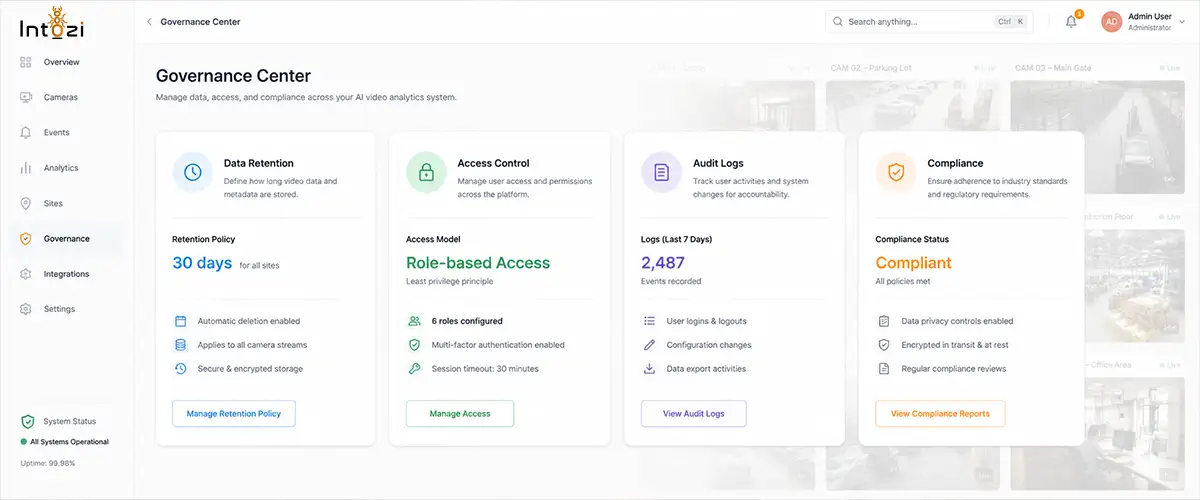
- Data minimization: retaining only what is necessary and purging footage on defined schedules
- Transparency: informing people when they are being monitored in public or commercial spaces
- Bias auditing: regularly testing AI models for demographic disparities in detection accuracy
- Access controls: limiting who can query surveillance data and under what conditions
- Regulatory alignment: staying current with GDPR, India’s DPDP Act, and sector-specific standards
An AI surveillance system that ignores these principles may deliver short-term capability but long-term liability. Intozi builds compliance considerations into its platform architecture, not as an afterthought, but as a foundational requirement.
The Intelligent Future Is Already Here
The intelligent video analytics platform of today is not a prototype or a pilot program. It is live, operational, and reshaping how organizations see, respond, and protect. From smart cities reducing crime through behavioral analytics to hospitals preventing patient harm through passive monitoring, the applications are as broad as the problems they solve.
Intozi stands at the intersection of this transformation, delivering surveillance intelligence that is accurate, scalable, ethical, and built for the realities of 2026 and beyond. The eyes that never blink are no longer a dystopian metaphor; they are a practical tool for a safer, smarter world when deployed responsibly.
Choosing the Right Intelligence Partner
Before investing in any surveillance upgrade, organizations should evaluate not just technology specs but vendor philosophy. The right partner understands that surveillance data is sensitive, that false positives carry real costs, and that long-term value comes from systems that improve over time. Intozi combination of deep AI expertise, scalable architecture, and ethics-first design makes it a compelling choice for organizations navigating the complexities of modern security. The question is no longer whether to adopt AI-powered surveillance; it’s whether to do it right.
Frequently Asked Questions (FAQs)
Upgrade Your Operations With Next-Generation AI Video Analytics
Intozi Tech Pvt Ltd
Unit no- 629, 644, 645 Tower B2, Spaze I-Tech Park, Sohna Road Sec 49, Gurgaon, Haryana-122018
MON-FRI 09:00 - 20:00, SAT 10:00 - 14:00